Health news
Health news top Health news

   Login  |  Register    
Health News Make AMN Your Home PageDiscussion BoardsAdvanced Search ToolMedical RSS/XML News FeedHealth news
  You are here : Health.am > Health Centers > Cancer Health CenterBreast Cancer • • Hereditary Breast Cancer

Functions of BRCA1 and BRCA2 and the Mechanism of Hereditary Susceptibility

Breast Cancer • • Hereditary Breast CancerJun 13, 2008

The functions of BRCA1 and BRCA2 are incompletely defined. The genes share little sequence homology, although there are some similarities in exon structure.

The susceptibility conferred by a germline mutation appears to follow the classic tumor-suppressor model, in that the normal copy of the gene must be mutated or lost before the predisposition can be expressed.

Current evidence suggests that the products of these genes function in a DNA-damage repair pathway (reviewed in ref. 8). Cells lacking BRCA1 or BRCA2 function appear to be defective in their ability to resolve double-stranded DNA breaks. 

Such cells appear to be prone to accumulate additional genetic damage, and are sensitive to the effects of DNA-damaging agents such as ionizing radiation and certain chemotherapeutic agents. The two gene products appear to participate in a common pathway and have been reported to physically coexist in a biochemical complex.

The exact mechanism by which loss of BRCA1 or BRCA2 function produces the observed predisposition to cancer is not known. One hypothesis suggests that loss of gene function is an early event, with cells lacking BRCA1 or BRCA2 being prone to acquire the additional genetic changes that lead to the malignant phenotype. The restricted tissue expression of this predisposition is currently unexplained.
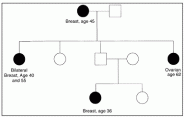

Fig. 11.1. Hereditary breast-ovarian cancer pedigree demonstrating autosomal dominant inheritance.

Mark E. Robson
Breast conservation therapy for invasive breast cancer in Ashkenazi women with BRCA gene founder mutations. J Natl Cancer Inst 2003

References

Provided by ArmMed Media

Email this to a friend Bookmark this! Printable Version

RELATED STORIES:


 Comments [ + Post Your Own

Now you're in the public comment zone. What follows is not Armenian Medical Network's stuff; it comes from other people and we don't vouch for it. A reminder: By using this Web site you agree to accept our Terms of Service. Click here to read the Rules of Engagement.

There are no comments for this entry yet. [ + Comment here + ]


We are pleased to let readers post comments about an article. Please increase the credibility of your post by including your full name and email.

All comments are reviewed by our editors before they are posted on the site. Just keep it clean, kids.

Name:

Email:

Location:

URL:

Remember my personal information

Notify me of follow-up comments?

Please enter the word you see in the image below:


   [advanced search]   
Interactive Quiz:
1. An infant who sits with only minimal support, attempts to attain a toy beyond reach, and rolls over from the supine to the prone position, but does not have a pincer grasp, is at a developmental level of
2 months
4 months
6 months
9 months
1 year


Health Centers

Health Centers


Diabetes


Health news


Health Encyclopedia

Diseases & Conditions

Drugs & Medications

Health Tools

Health Tools


   Health newsletter


   Medical Links


   RSS/XML News Feed


   Feedback


Breast Cancer news from Armenian Medical Network
Add to My AOL
Add to Google Reader or Homepage


HIV-AID. HIV Express Test Kit

hit counter