
Breast Cancer Risk Factors
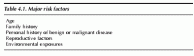
While there are many factors that have been postulated to influence breast cancer risk, only a small number are felt to be significant. Table 4.1 outlines these major risk factors.
Age
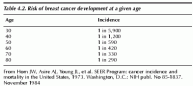
Increasing age is associated with an increasing risk of breast cancer. Over-whelmingly, age is the most significant risk factor for breast cancer development. Prior to menopause, the likelihood that a woman will develop breast cancer is relatively low. At menopause, there appears to be a plateau in risk, after which there is again a slow rise in incidence. While it is true that one in nine women will develop breast cancer in their lifetime, it is more helpful to define risk by the actual incidence at a given point in time a woman’s life.
Table 4.2 summarizes the likelihood that a woman at a particular age will develop breast cancer. While it demonstrates that, even at the age of 80, the risk of breast cancer is not one in nine, it also underscores the fact that breast cancer is much more likely to occur in the postmenopausal years.
Family History
By far, the majority of breast cancer cases are sporadic in nature. Familial or hereditary factors are implicated in the development of only 25% of all breast cancers.
Table 4.1. Major risk factors
- Age
- Family history
- Personal history of benign or malignant disease
- Reproductive factors
- Environmental exposures
Despite this, it is still important to identify the patient who might be at increased risk due to a family history of breast cancer. By documenting the family history of a woman, a physician can determine the magnitude of increased risk that a given patient might experience.
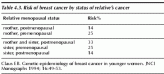
While any family history of breast cancer does increase a woman’s risk of future breast cancer development, that increase is often insignificant. If a single first- or second-degree maternal relative of a woman had breast cancer postmenopausally, the absolute increase in breast cancer risk for that woman is negligible. At least one-half of the cases of breast cancer in which family history is documented fall into this category. Table 4.3 illustrates the lifetime risk of breast cancer development when various relatives have a history of breast cancer.
Much more significant in terms of increased risk of breast cancer development is the documented or presumed presence of an inherited susceptibility gene. Approximately 10% of breast cancers develop as a result of a mutation in a gene. Currently, mutations in two genes, BRCA1 and BRCA2, have been identified.
Mutations in these two genes are likely to account for approximately 80% of inherited breast cancer cases. This type of mutation is more likely to be present in families in which the breast cancer cases are present in multiple females in multiple generations, are premenopausal and are bilateral. Additionally, a large proportion of families that carry the BRCA1 mutation, cases of ovarian cancer have also existed. While the clinical scenario associated with these mutations will be discussed in greater detail in another chapter, it is important to be aware of their contribution to risk of breast cancer.
Table 4.3. Risk of breast cancer by status of relative’s cancer
An individual whose mother carries such a mutation has a 50% probability of inheriting that mutation. If a patient carries a mutation, the lifetime risk of breast cancer has been estimated to be anywhere from 60-90%.
Furthermore, the likelihood of contralateral disease after an index breast cancer is over 50%.