
Pathophysiology of Glucose Counter-Regulation
PATHOPHYSIOLOGY OF GLUCOSE COUNTER-REGULATION
While marked hyperinsulinemia alone can cause hypoglycemia, iatrogenic hypoglycemia is the result of the interplay of relative or absolute insulin excess and compromised physiological and behavioral defenses against falling plasma glucose concentrations in type 1 diabetes and in advanced (i.e., insulin-deficient) type 2 diabetes (Table 3) (5,6).
Normally, decrements in insulin are the first physiological defense and increments in glucagon are the second defense against falling plasma glucose concentrations. Increments in epinephrine, the third defense, become critical when glucagon is deficient.
Decrements in insulin and increments in glucagon and epinephrine increase endogenous glucose production; epinephrine also limits glucose clearance in insulin-sensitive tissues.
The sympathoadrenal response (largely the sympathetic neural response) to hypoglycemia causes neurogenic symptoms and thus prompts the behavioral defense, the ingestion of food. All of these defenses are compromised in insulin-deficient diabetes (Table 3) (5,6). In the setting of absent decrements in insulin and absent increments in glucagon, attenuated epinephrine responses cause defective glucose counter-regulation. Attenuated sympathoadrenal, largely sympathetic neural, responses cause hypoglycemia unawareness, loss of the warning symptoms that previously prompted food ingestion.
The concept of HAAF in diabetes (Fig. 2) posits that recent antecedent hypoglycemia causes both defective glucose counterregulation (by reducing the epinephrine response to a given level of subsequent hypoglycemia in the setting of absent decrements in insulin and absent increments in glucagon) and hypoglycemia unawareness (by reducing the sympathoadrenal and the resulting neurogenic symptom responses to a given level of subsequent hypoglycemia) and thus a vicious cycle of recurrent hypoglycemia.
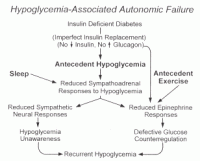
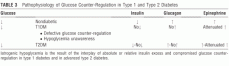 TABLE 3 Pathophysiology of Glucose Counter-Regulation in Type 1 and Type 2 Diabetes
Sleep and prior exercise have similar effects (5). Developed in type 1 diabetes, the concept of HAAF also applies to advanced type 2 diabetes. Insulin secretion decreases progressively and hypoglycemia becomes more limiting to glycemic control over time in type 2 diabetes. As the patients become absolutely insulin deficient, insulin levels do not decrease and glucagon levels do not increase as plasma glucose concentrations fall in type 2 diabetes, as in type 1 diabetes. Furthermore, recent antecedent hypoglycemia shifts the glycemic thresholds for sympathoadrenal and symptomatic responses to subsequent hypoglycemia to lower plasma glucose concentrations in type 2 diabetes, as in type 1 diabetes. Thus, people with advanced type 2 diabetes are also at risk for HAAF. This may well explain why the frequency of iatrogenic hypoglycemia increases from uncommon early in the course of type 2 diabetes, when glucose counterregulatory defenses are intact, to common as patients approach the insulin-deficient end of the spectrum of type 2 diabetes.
The clinical impact of HAAF is well established, at least in type 1 diabetes.
Remarkably, as little as 2 to 3 weeks of scrupulous avoidance of iatrogenic hypoglycemia reverses hypoglycemia unawareness and improves the epinephrine response in most affected patients. On the other hand, the specific mechanisms of HAAF are largely unknown (21).
Philip E. Cryer
Washington University School of Medicine, St. Louis, Missouri, U.S.A.
REFERENCES