
Frequency of Hypoglycemia
Hypoglycemia is a fact of life for most people with established (i.e., C-peptide negative) type 1 diabetes (5,6). Those attempting to achieve some degree of glycemic control suffer untold numbers of episodes of asymptomatic hypoglycemia; plasma glucose concentrations may be < 50 mg/dL (2.8 mmol/L) 10% of the time. They suffer an average of two episodes of symptomatic hypoglycemia per week - thousands over a lifetime of diabetes - and episodes of severe, at least temporarily disabling hypoglycemia approximately once a year
(Table 1).
Indeed, an estimated 2% to 4% of deaths of people with type 1 diabetes have been attributed to hypoglycemia.
Over a lifetime of diabetes, the incidence of iatrogenic hypoglycemia is considerably lower in type 2 diabetes than in type 1 diabetes. As discussed later, this likely reflects intact defenses against falling plasma glucose concentrations early in the course of the disease.
Ascertainment of hypoglycemia is a challenge. Asymptomatic episodes will be missed unless they are detected by routine glucose monitoring. Mild to moderate symptomatic episodes may not be recognized. Even if recognized, they are soon forgotten. Episodes of severe hypoglycemia (those requiring the assistance of another person) are more dramatic events that are more likely to be recalled (by the patient or by a witness). Therefore, when based on patient recall, estimates of the severe hypoglycemia event rates are more reliable although they represent only a small fraction of the hypoglycemic experience.
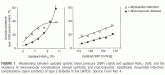
FIGURE 1 Relationship between updated systolic blood pressure (SBP) (right) and updated HbA1C (left), and the incidence of microvascular complications (closed symbols) and macrovascular, specifically myocardial infarction, complications (open symbols) of type 2 diabetes in the UKPDS. Hypoglycemia occurs in people with type 2 diabetes treated with insulin or with a sulfonylurea or another insulin secretagogue such as repaglinide or nateglinide. Insulin sensitizers (e.g., metformin or a thiazolidinedione), GLP-1 analogues or receptor agonists and DPP-IV inhibitors should not cause hypoglycemia when used as monotherapy, although metformin has been reported to do so (Table 2) (7). In general, insulin secretion decreases appropriately as plasma glucose concentrations decline, and hypoglycemia does not occur, when these drugs are used. However, all of these increase the risk of hypoglycemia when used with an insulin secretagogue or insulin. In that regard, it should be recalled that the majority of people with type 2 diabetes ultimately require treatment with insulin. Severe hypoglycemia event rates have been reported to range from 62 to 170 episodes per 100 patient-years in type 1 diabetes and from 3 to 73 episodes per 100 patient-years in insulin-treated type 2 diabetes (Table 1). Hypoglycemia event rates in the UKPDS in type 2 diabetes have not been reported, but 11.2% of the patients treated with insulin and 3.3% of those treated with a sulfonylurea suffered a hypoglycemic event requiring medical assistance over 6 years (Table 2). TABLE 1 Severe Hypoglycemia during Aggressive Therapy of Diabetes
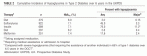
TABLE 2 Cumulative Incidence of Hypoglycemia in Type 2 Diabetes over 6 years in the UKPDS The frequency of hypoglycemia is highest in type 2 diabetes patients treated with insulin (Table 2) (7). That may well be because of the greater glucose-lowering potency of that drug - given in sufficient doses - relative to that of the other drugs, and its pharmacokinetic imperfections. However, it may also be because many patients who ultimately require treatment with insulin have advanced, insulin-deficient type 2 diabetes with the resulting compromised defenses against falling plasma glucose concentrations (5,6) discussed later in this section. Philip E. Cryer Washington University School of Medicine, St. Louis, Missouri, U.S.A. REFERENCES