
New articles examine safety of airport security scanners
The Transportation Security Administration (TSA) has begun to use whole-body imaging scanners as a primary screening measure on travelers passing through airport security checkpoints. One type of scanner employs millimeter wave technology, which delivers no ionizing radiation. However, the second type of scanner currently deployed at airports uses backscatter X-rays that expose the individual being screened to very low levels of ionizing radiation. In the April issue of Radiology, two articles address the question of what potential long-term public health threats, if any, these backscatter X-ray systems pose.
In the first article, David J. Brenner, Ph.D., D.Sc., director of the Center for Radiological Research at Columbia University Medical Center in New York, N.Y., proposes that from a public health policy perspective, given that up to one billion such scans per year are now possible in the U.S, we should have concerns about the long-term consequences of an extremely large number of people being exposed to a potential radiation-induced cancer risk, no matter how slight.
“The risks for any individual going through the X-ray backscatter scanners are exceedingly small,” Dr. Brenner said. “However, if all air travelers are going to be screened this way, then we need to be concerned that some of these billion people may eventually develop cancer as a result of the radiation exposure from the X-ray scanners.”
In the second article, David A. Schauer, Sc.D., C.H.P., executive director of the National Council on Radiation Protection and Measurements (NCRP), argues that the summation of negligible average risks over large populations or time periods into a single value produces a distorted image of risk that is out of perspective with risks accepted every day, both voluntarily and involuntarily.
“There is no scientific basis to support the notion that a small risk to an individual changes in any way for that individual as others around him are also exposed to the same source of radiation,” he said. “Critics of security screening acknowledge that doses from backscatter X-ray systems are very low and safe for an individual.”
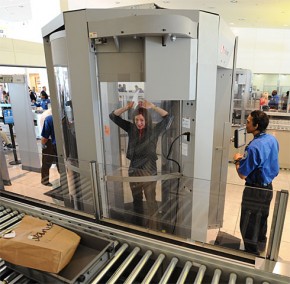 Dr. Schauer advocates strict regulatory control of the backscatter scanners in order to ensure that their use is consistent with the goals and objectives of radiation protection, which include justification (benefits exceed cost or harm), optimization (exposures are kept as low as reasonably achievable) and limitation (individual doses are limited).
“Any decision that alters the radiation exposure situation should do more good than harm,” Dr. Schauer said. “In other words, people should only be exposed to ionizing radiation for security screening purposes when a threat exists that can be detected and for which appropriate actions can be taken. In addition, exposures must be justified and optimized.”
Both Dr. Brenner and Dr. Schauer agree that the scanners using millimeter wave technology should be considered as a first option, since they are similar in cost and functionality to the backscatter machines, but do not expose the passenger to ionizing radiation. However, they also say that the average traveler should not be overly concerned about being screened with the backscatter scanners.
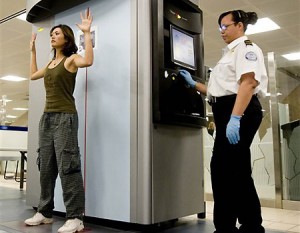 “As someone who travels just occasionally, I would have no hesitation in going through the X-ray backscatter scanner,” Dr. Brenner said. “Super frequent fliers or airline personnel, who might go through the machine several hundred times each year, might wish to opt for pat-downs. The more scans you have, the more your risks may go up—but the individual risks are always going to be very, very small.”
NCRP has recommended that backscatter X-ray systems adhere to an effective dose of 0.1 microsieverts (µSv) or less of ionizing radiation per scan, which roughly equates to the radiation exposure each passenger receives in under two minutes on the plane while flying at 30,000 feet. The average person in the U.S. receives an effective dose of about 3 millisieverts (3,000 µSv) per year from naturally occurring radioactive materials and cosmic radiation from outer space.
###
“Are X-ray Backscatter Scanners Safe for Airport Passenger Screening? For Most Individuals, Probably Yes, but a Billion Scans per Year Raises Long-Term Public Health Concerns.” David J. Brenner, Ph.D., D.Sc.
“Does Security Screening with Backscatter X-rays Do More Good than Harm?” David A. Schauer, Sc.D., C.H.P.
Radiology is edited by Herbert Y. Kressel, M.D., Harvard Medical School, Boston, Mass., and owned and published by the Radiological Society of North America, Inc. (http://radiology.rsna.org/)
RSNA is an association of more than 46,000 radiologists, radiation oncologists, medical physicists and related scientists committed to excellence in patient care through education and research. The Society is based in Oak Brook, Ill. (RSNA.org)
###
Contact: Linda Brooks
.(JavaScript must be enabled to view this email address)
630-590-7762
Radiological Society of North America