
Chocolate ‘Offenders’ Teach Science a Sweet Lesson
Some ‘chocoholics’ who just couldn’t give up their favorite treat to comply with a study to test blood stickiness have inadvertently done their fellow chocolate lovers - and science - a big favor.
Their ‘offense,’ say researchers at Johns Hopkins led to what is believed to be the first biochemical analysis to explain why just a few squares of chocolate a day can almost halve the risk of heart attack death in some men and women by decreasing the tendency of platelets to clot in narrow blood vessels.
‘What these chocolate ‘offenders’ taught us is that the chemical in cocoa beans has a biochemical effect similar to aspirin in reducing platelet clumping, which can be fatal if a clot forms and blocks a blood vessel, causing a heart attack,’ says Diane Becker, M.P.H., Sc.D., a professor at The Johns Hopkins University School of Medicine and Bloomberg School of Public Health.
Becker cautions that her work is not intended as a prescription to gobble up large amounts of chocolate candy, which often contains diet-busting amounts of sugar, butter and cream. But as little as 2 tablespoons a day of dark chocolate - the purest form of the candy, made from the dried extract of roasted cocoa beans - may be just what the doctor ordered.
Researchers have known for nearly two decades that dark chocolate, rich in chemicals called flavonoids, lowers blood pressure and has other beneficial effects on blood flow. The latest Hopkins findings, to be presented Nov. 14 at the American Heart Association’s annual Scientific Sessions in Chicago, identified the effect of normal, everyday doses of chocolate found in ordinary foods, unlike previous studies that found decreased platelet activity only at impractically high doses of flavonoids equivalent to eating several pounds of chocolate a day. 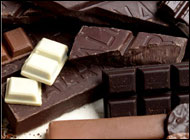
“Eating a little bit of chocolate or having a drink of hot cocoa as part of a regular diet is probably good for personal health, so long as people don’t eat too much of it, and too much of the kind with lots of butter and sugar,” says Becker.
In the study, 139 people Becker - whom Becker somewhat tongue in cheek calls “chocolate offenders” - were disqualified from a much larger study looking at the effects of aspirin on blood platelets. The Genetic Study of Aspirin Responsiveness (GeneSTAR) was conducted at Hopkins from June 2004 to November 2005 and enrolled more than 500 men and 700 women participants nationwide.
Shortly before aspirin dosing began for the subjects, they were told to stay on a strict regimen of exercise and to refrain from smoking or using foods and drinks known to affect platelet activity. These included caffeinated drinks, wine, grapefruit juice - and chocolate.
The non-compliers - who admitted to eating chocolate - were a diverse group who got their flavonoid “fix” from a variety of sources, including chocolate bars, cups of hot cocoa, grapes, black or green tea, and strawberries. And while they were excluded from the aspirin study, Becker and her team scoured their blood results for chocolate’s effect on blood platelets, which the body recycles on a daily basis.
When platelet samples from both groups were run through a mechanical blood vessel system designed to time how long it takes for the platelets to clump together in a hair-thin plastic tube, the chocolate lovers were found to be less reactive, on average taking 130 seconds to occlude the system. Platelets from those who stayed away from chocolate as instructed clotted faster, at 123 seconds.
In another key test of urine for waste products of platelet activity, primarily urinary thromboxane (11-dehydro-thromboxane B2), scientists found that chocolate eaters showed less activity and waste products on average, at 177 nanograms per millimol of creatinine, versus an average of 287 nanograms per millimol of creatinine in the group that abstained.
Participants ranged in age from 21 to 80; 31 percent were black and the rest were white. In total, more than 200 different tests of platelet reactivity were performed and analyzed in the study. Because whole blood contains other cells that affect platelet aggregation, testing was repeated using a purified version of test samples made up of strictly platelet-rich plasma.
None of the “offenders” had previous histories of heart problems, such as a heart attack, but all were considered to be at slightly increased risk of heart disease because of family history. Fifty percent of women participants were postmenopausal.
“These results really bring home the point that a modest dietary practice can have a huge impact on blood and potentially on the health of people at a mildly elevated risk of heart disease,” says study co-author Nauder Faraday, M.D., an associate professor at Hopkins. “But we have to careful to emphasize that one single healthy dietary practice cannot be taken alone, but must be balanced with exercise and other healthy lifestyle practices that impact the heart.”
Besides Becker and Faraday, other investigators in this research were Lisa Yanek, M.P.H.; Taryn Moy, M.S.; and Lewis Becker, M.D.
Revision date: June 22, 2011
Last revised: by Sebastian Scheller, MD, ScD