
Friendship and intimacy module
Although few psychiatric rehabilitation programs have comprehensively addressed the friendship and intimacy needs of seriously mentally ill persons, the studies conducted to date have demonstrated the feasibility of their use and participants’ enthusiasm for the subject matter. Given the apparent need for this type of material, practitioners’ difficulties with expressing sexual material cannot fully explain the relative rarity of such programs.
Perhaps another contributing factor is that deficiencies in vital areas of social functioning of many individuals with serious mental illness potentially obscure from the clinician’s view the importance of their sexuality.
It is not surprising, therefore, that sexuality issues frequently arise in the context of social skills training, because this modality is geared toward eliciting the goals and desires of participants. As such, skills training technology is a place to start when constructing a program to provide explicit instructions to individuals with serious mental illness in the realms of friendship, dating, intimacy, and sexuality.
Skills training closes the gap between the individual’s current skills and those needed for improved functioning.
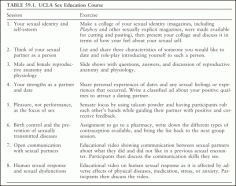 TABLE 59.1. UCLA Sex Education Course
The methods used to teach friendship, and safe and satisfying sex are based on motivational enhancement and behavioral learning principles:
- Ensure that patients “buy into” the module through identifying its relevance to their own personal goals.
- Understand the benefits to patients of learning the skills from a personal frame of relevance.
- Specify the know-how and skills to be trained; check for understanding.
- Demonstrate the skills. Learn by watching videotaped models and answering patients’ questions to ensure that they have internalized the skills.
- Have patients practice the skills until they can perform them competently. Provide abundant positive reinforcement for patients who approximate criteria of competence.
- Teach patients to employ the skills in everyday life and gain reinforcement from the group, the trainer, and people in the natural environment.
Schizophrenia and Sexuality
- Sexual activity of persons with schizophrenia
- Sexual dysfunction affecting persons with schizophrenia
- Vulnerability of this population to sexually transmitted diseases
- Psychoeducational programs for teaching safe sex
- Friendship and intimacy module
- Clinical Experience with the Friendship and Intimacy Module
- Training the trainers
- - Key Points
Developing the curricula to teach friendship and intimacy skills is neither quick noreasy. Moreover, the instructional techniques must compensate for individuals’ cognitive dysfunctions that might interfere with learning. Liberman and colleagues (1993) addressed this difficulty by producing a series of eight “modules” that teach community living skills with thoroughly specified curricula and highly structured training steps: Medication Self-Management, Symptom Self-Management, Substance Abuse Management, Recreation for Leisure, Basic Conversation, Workplace Fundamentals, Community Reentry and, most recently, Friendship and Intimacy. All use the same behavioral learning activities and problem-solving exercises to train each skill in each module. Only the content varies among modules, and the repetition of the learning activities provides a predictable teaching environment that enables trainers to conduct the modules and individuals to acquire the skills.
The Friendship and Intimacy module uses a plot line that follows a couple whose relationship develops from friendship and dating to the considerations and problem solving regarding the pros and cons of engaging in sex. In the context of a maturing relationship, the partners demonstrate appropriate communication skills with each other, with trusted friends and relatives, and with health care professionals. After evaluating their relationship and how it might change if they engaged in sexual intimacy, they decide gradually to engage in physical affection and ultimately sexual intercourse.