|
No one knows why they occur and it is not possible to prevent them.
Babies can have corrective surgery during their first year.
But now UK scientists are looking into whether "baby plates" - added within days of birth - help the child develop by making it easier for them to eat and then talk.
A routine scan at 20 weeks broke the devastating news to Hayley and Rob Brinkman that their baby had a birth defect.
The scanner had picked up a cleft lip and palate.
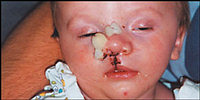 Even though Rob had been born with a severe cleft lip and palate himself he admitted that the news was devastating. Even though Rob had been born with a severe cleft lip and palate himself he admitted that the news was devastating.
"We thought that our world had collapsed.
Cleft lip and palate
Cleft lip and palate affects one in 500-700 births in the UK
Cleft means split or separation
A cleft lip is a condition that creates an opening in the upper lip between the mouth and nose, whereas a cleft palate occurs when the roof of the mouth has not joined completely
A cleft can occur on one or both sides of the face
"We were always aware that there might be a chance that our children would develop the same condition, but you never truly think you'll be affected. "We took some solace from the fact that the defect was only a cosmetic one, and heaven forbid he wasn't being born with something more disabling such as blindness."
Sam had corrective surgery to repair the gaps, once at three months for a single split to his lip and again at six months for a double gap in the palate.
He might need further surgery at a later date to ensure that his adult teeth grow properly.
'Important impact'
The Brinkmans agreed to put Sam into a trial with the charity Action Research to test the use of "baby plates", although he was put into the group chosen not to wear the plates.
The "baby plates" are small acrylic plates which are fitted within days of birth and then worn by the baby until surgery.
Some doctors think the plates improve feeding and facial growth and assist with surgery and developing speech, by narrowing the cleft gap.
But the plates are expensive at Ј3,000 each and until now there has been no hard evidence to show that they work.
Now Anthea Masarei, a speech and language therapist at London's Great Ormond Street Hospital, is carrying out a one-year study to see whether the plates work.
She said: "There has been no hard evidence to support reports that "baby plates" do actually achieve the feeding and speech claims.
"We are looking to identify the scientific evidence to justify these.
"The research study could potentially have an important impact on clinical practice and the management of babies with cleft lip and palate."
[BBC News Online]
««« »»»
Last Revised at December 10, 2007 by Lusine Kazoyan, M.D.
|