|
The poetic idea that the eyes are a window into the heart has long been taken seriously by cardiologists. They know that abnormalities of the tiny blood vessels of the retina can indicate similar problems with blood vessels inside the body, problems that can lead to a heart attack or stroke. A new study carries the idea further, saying that retinal blood vessels might be used for early detection of Alzheimer's disease and other cognitive problems and might open a new path toward treatment of them.
"The blood vessels at the retina provide a window to look directly at changes in the small arteries in the brain," explains Dr. Tien Yin Wong, the study's lead author and a professor of ophthalmology at the National University of Singapore. "Thus, changes in the retinal arteries, termed retinal microvascular abnormalities, may be linked to similar vessel changes in the brain."
Wong and his colleagues tested that idea by taking pictures of the retinas of more than 8,700 volunteers in four U.S. communities. In a 10-year follow-up, those who developed impaired mental function were about three times more likely to have had abnormalities of the retinal blood vessels, the researchers report in the June issue of Stroke: Journal of the American Heart Association.
That finding was not a surprise, Wong says, since it arose from an earlier study of the relationship between retinal vessels and stroke.
"In our previous study, we found that people with these retinal vessel changes are two to three times more likely to develop stroke," he says. "In the current study, after excluding people with stroke, we find that healthy people with these changes are two to three times more likely to have poorer cognitive function."
The hopeful aspect of the finding, the researchers say, is the indication that blood vessel problems play a role in such conditions as Alzheimer's disease, and that those conditions might be helped by the kind of treatments used to reduce the risk of heart attack and stroke. Current treatment for Alzheimer's disease and other dementia is limited, and is not aimed at blood vessels.
It's a logical idea, says Dr. Larry B. Goldstein, a professor of medicine at the Duke University Medical Center and a spokesman for the American Heart Association. "Preventive therapies that try to reduce the progression of vascular diseases might also prevent the progression of cognitive problems," he says.
While the new study is more suggestive than conclusive, Goldstein says, putting its findings to use in medical practice can't do harm and will do some good.
"The pathological link is not there yet, and the treatment link is not there yet," he says of the retina-brain connection. "But what this points out is the importance of actively identifying and treating risk factors. Then we have to be very, very aggressive in our preventive therapy."
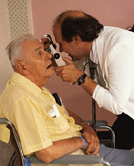
The study was done by having technicians look at photographs of the retina, and "therefore is a research and not a clinical tool," Wong says. "However, many of these changes can be detected clinically by an ophthalmologist examining the retina."
It needn't be an ophthalmologist, Goldstein says. "In principle, a thorough examination of the eyes is something that should be a part of every physical examination," he says. "Whether the physician does it is another story."
[HealthScoutNews]
««« »»»
Last Revised at December 10, 2007 by Lusine Kazoyan, M.D.
|