|
Work is under way on the development of a hand-held scanner that would allow GPs to give a preliminary diagnosis of breast cancer within minutes. A team of computer specialists and surgeons at the University of Dundee are attempting to develop an ultrasound technique to detect breast cancers at an early stage.
It is based on the fact that cancer tissue is much stiffer than healthy tissue.
A technique known as "Doppler imaging" is used to examine tissue while a small vibration is applied.
The cancerous area moves less than healthy parts and shows up as a different colour on the picture.
Professor Ian Ricketts, from the Department of Applied Computing, said: "Our aim is to detect tumours that are too small or too undeveloped to be detected on X-rays.
"This technology cannot be used where bone gets in the way, such as inside the skull, but it would work well in the breast or abdomen."
Precise position
|
"This collaborative research project has the potential to help in screening for a range of common cancers." |
Professor Ian Ricketts
University of Dundee |
The use of ultrasound would have the added benefit of reducing the risks posed by X-rays and the need for expensive equipment in specialised clinics, Professor Ricketts added.
The Dundee team is developing a system that takes many ultrasound views of a "slice" of the patient's body and produces a 3D image.
This will improve the ability to detect the exact position of a tumour.
The system would reduce the need for X-rays
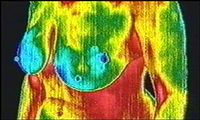 In Scotland alone, more than 3,000 women are diagnosed with breast cancer each year.
About half of those diagnosed with localised breast cancer will eventually develop metastatic cancer - where the cancer cells spread to other parts of the body.
Professor Ricketts went on: "This collaborative research project has the potential to help in screening for a range of common cancers.
"Although our present studies focus on breast cancer, which affects 38,000 women in the UK every year, the approach could equally apply to other common tumour sites including the prostate, which currently affects over 21,000 males in the UK."
[BBC News Online]
««« »»»
Last Revised at December 10, 2007 by Lusine Kazoyan, M.D.
|