|
A drug which might help patients with hard-to-treat forms of brain tumour uses poisons made by the diptheria bacteria. TransMID is about to start the latest stage of its clinical trials, and previous research has suggests it may be more effective against malignant glioma.
Approximately half of all brain tumours in adults are malignant gliomas.
They are often unsuitable for surgery because it is hard to cut out all the cells at the edge of the tumour.
And glioma cells can prove resistant to both chemotherapy and radiotherapy.
One of the biggest problems with this kind of tumour is finding a treatment which will target the cancer cells without wreaking havoc in surrounding, healthy brain cells - which the patient badly needs to maintain normal function.
Trojan horse
TransMID works by "tricking" the cancer cell into allowing the diptheria toxin into the cell.
Diptheria, while now rare, is a dangerous lung infection - there are only a handful of cases each year, mainly in unimmunised children and older people who never received the jab.
The bacteria kill because they produce such a powerful poison as part of their natural cycle.
TransMID is a combination of the toxin and a protein called transferrin, whose role is normally to carry iron into the cell.
Cancer cells tend to need more iron than other brain cells, so their uptake of the modified transferrin is greater than surrounding tissue.
Once the toxin is inside the cell, it is separated from the protein and kills it.
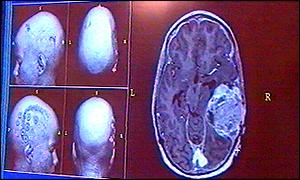
The drug's makers suggest that damage to surrounding cells will be minimised.
Encouragement
Study results from early trials suggest that it could be a better prospect for malignant glioma patients than continuing with conventional therapy.
It was tested on patients whose tumours had recurred after the first line of treatment, who normally have a very poor prognosis.
Of the 34, five patients had what was described as "complete response" to the drug, with the tumour appearing to disappear completely on scans.
Sixteen patients had a partial response, and the rest either did not respond or saw only small reductions in the size of the tumour.
Normally, survival for these patients once a tumour has recurred is only, on average, 26 weeks.
However, 13 of the patients survived for more than one year, and one for more than four following extra treatment.
Doctors from South Carolina Medical University, one of the centres studying the drug, are encouraged by the response in such a hard to treat group.
"The proportion of the patients responding to TransMID was far in excess of our original goal of 5%," he said.
A much larger study is due to begin this year.
[ ArmMed Media ]
«««
Last Revised at December 10, 2007 by Lusine Kazoyan, M.D.
|