|
A new type of gene therapy has the potential to stop breast cancer cells spreading around the body, scientists claim. It is hoped that a technique developed by scientists from the charity Cancer Research UK and King's College London will enable women with breast cancer to be treated before surgery.
Cancer cells are held in place within the tumour, increasing the chances of a successful operation to remove the malignant tissue.
The technique works by using a specially modified virus to insert a fragment of genetic material called a minigene into the cancer cells.
The target is a molecule within the cells called PKC alpha which plays an important role in helping to instruct cancer cells to move in a particular direction.
Minigene
The minigene provides the genetic information for a tiny protein molecule that is designed to interfere with PKC alpha's activity.
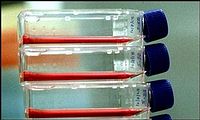
Scientists grew cancer cells in the laboratory and tracked their movement in response to signals encouraging them to spread.
Uninfected cells moved rapidly in the direction of the signals. But among infected cells, PKC alpha could no longer help cells to respond to signals and their ability to move was reduced by 90%.
Team leader Dr Tony Ng said: "One of the most distinctive features of a cancer cell is its ability to respond to chemical signals and begin to move through the tissues surrounding it.
"Blocking the ability of cancer cells to follow instructions to move may be an effective way of preventing the disease from spreading."
|
"Blocking the ability of cancer cells to follow instructions to move may be an effective way of preventing the disease from spreading " |
|
Dr Tony Ng |
Great potential
Scientists believe that the gene therapy has particular potential against tumours in which PKC alpha is highly active, since these may be especially reliant on the molecule.
Doctors might be able to test tumours at the time of diagnosis for the presence of this active molecule in order to identify those best suited to the treatment.
Fellow researcher Dr Peter Parker, of the Cancer Research UK London Research Institute, said: "In the laboratory the new system has been extremely successful at preventing cancer cells from moving around.
"We now need to find the best way of getting the virus into tumours, so women with breast cancer could benefit.
"The treatment might be particularly useful around the time of surgery to remove a tumour, since this is a time when cancer cells may break away from a tumour and spread around the body."
[ ArmMed Media ]
«««
Last Revised at December 10, 2007 by Lusine Kazoyan, M.D.
|