|
A treatment that replaces most of the body's immune system with cancer fighting cells shrank the melanomas of some seriously ill patients, researchers report. The findings appear in the journal Science, published by the American Association for the Advancement of Science.
The therapy takes advantage of the immune system's ability to deliver a specially targeted assault on an unwanted invader, and helps boost that assault by multiplying the number of immune cells involved inside the patient's body. This approach may also work for treating other cancer types, as well as infectious diseases, such as AIDS, according to the researchers.
Unlike many other cancer studies, which are done on mice, this study was done on human patients, who had not responded to standard therapies.
"To be able to do something as complex as this in humans, where every human is different and every tumor is different, has been quite difficult," said study author Steven Rosenberg of the National Cancer Institute.
The body's immune system can produce a set of T cells that attack tumors, but often these alone aren't a match for aggressive cancer. In the past, researchers have tried to boost these cells' numbers by extracting some from patients, inducing them to multiply in culture, and then transferring the expanded population back into the patients. The cells generally failed to "stick," however and disappeared quickly after the transfer.
By suppressing the patients' immune systems to "make room" for the new cells, as physicians do during a tissue transplant, Rosenberg and his colleagues induced the transferred cells to remain and grow in the body and start killing the tumor cells. In two cases, the transferred cells repopulated the patients' blood, becoming the dominant type of active T cell.
"It's very rare to be able to sustain large numbers of T cells in the body," said Rosenberg. "When your body fights the flu, maybe three percent of the T cells are active. In one of our patients, 90 percent of the T cells were active, and they sustained themselves for over four months. That's a striking occurrence."
The researchers studied 13 patients in the advanced stages of melanoma that had resisted the usual treatments. The researchers removed parts of the patients' tumors, which contained relatively small amounts of anti-tumor T cells, and grew the T cells in culture, until they had multiplied by approximately 1,000 times.
Before transferring the cells to the patients, Rosenberg's team gave the patients a round of chemotherapy that suppressed their immune systems' tendency to reject new cells. A few days after the T cell transfer, the number of tumor-fighting T cells shot up in more than half of the patients. After the transfer, the cells proliferated and traveled to the tumor sites, the scientists found.
"We generated and grew cells in the body to numbers that have never been approached before," Rosenberg said.
Four of the 13 patients had mixed responses, in which certain tumors shrank while others did not. Six others had clear regression of tumors at a variety of sites in the body, lasting from two to 21 months, the authors report.
Of these six, "patient 9" showed a regression of more than 95 percent of his melanoma, results that were ongoing 8 months later. Ninety-nine percent of "patient 10's" tumors had disappeared 7 months after the treatment, according to the study.
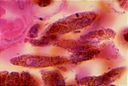
The researchers are currently working to improve the therapy so that a greater proportion of patients respond the way patients 9 and 10 did, Rosenberg said.
T cells are usually made up of a number of subfamilies, each capable of recognizing a slightly different type of antigen. Antigens are the molecules that trigger an immune response, whether they are from foreign pathogens or the body's own cells. In several of the patients, a relatively large portion of T cells (around 90 percent in patient 10) consisted of a single subfamily, the researchers found.
For patients 9 and 10, that subfamily turned out to be primed to attack a particular antigen called "MART-1." The antigen is involved in producing pigmentation, and is thus found in normal skin and iris cells, as well as in melanomas.
Some of the patients who had positive responses to the therapy developed certain forms of autoimmunity, in which their T cells reacted to MART-1 antigens in healthy tissue. Patient 9 and some others developed vitiligo, a skin disorder that produces white patches of skin. Patient 10 developed uveitis, which is inflammation in the iris, and was treated successfully with steroid drops, the authors report.
The researchers didn't observe any autoimmune disorders more serious than vitiligo and uveitis, according to Rosenberg. If the therapy works on tumors, "it's a small price to pay for getting rid of your cancer," he said.
[ ArmMed Media ]
««« »»»
Last Revised at December 10, 2007 by Lusine Kazoyan, M.D.
Last Revised at December 10, 2007 by Lusine Kazoyan, M.D.
|