|
Scientists hope that the zebrafish may help them to develop new treatments for cancer.
At first sight the tiny fish may seem to have nothing in common with humans.
But in fact its genome is thought to contain about 30,000 genes, roughly the same number as humans.
Many of its genes appear to play the same function as their equivalents in humans.
And the fish are also known to develop an array of tumours similar to those in humans.
Scientists have already used the zebrafish to carry out useful work on heart disease, and now equally important work has been carried out on cancer.
Over-active
Using gene therapy techniques, a team of US researchers have stimulated the development of a type of leukaemia in the fish.
They believe the breakthrough could help to isolate the genes that accelerate or delay the spread of the disease - T cell acute lymphoblastic leukemia (ALL) - in humans.
The scientists generated ALL in the fish by causing a key cancer gene to become overactive.
They fused the gene Myc, which plays an important role in human leukemia and lymphoma, to a zebrafish gene that works exclusively in lymphoid cells - the type of cells that become diseased in leukemia.
They then tagged the fused gene with a third gene that would cause leukemia cells to glow green under fluorescent light - enabling them to observe the cancer as it progresses through the animals' bodies.
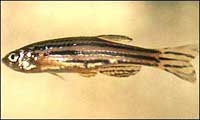
The three-gene combo was then injected into embryonic zebrafish, causing the genes to be incorporated in all of the developing fish's cells.
Cancer developed in virtually all the fish that carried a functional Myc gene.
Other genes
The creation of zebrafish genetically programmed to develop leukemia will enable researchers to screen thousands of zebrafish genes for those that, in mutated form, contribute to the disease.
Although Myc is involved in the cancer process, it does not act alone, but in concert with other genes.
The goal is to find those other abnormal genes.
The next stage will be to create fish which carry mutations of different genes.
By tracking which fish develop leukemia unusually quickly or unusually slowly, investigators hope to identify mutations that promote cancer and those that deter it.
They also plan to test the effect of various anti-cancer agents on the fish that are prone to developing the disease.
Researcher Dr Thomas Look, of Dana-Farber Cancer Institute, said: "The development of this line of zebrafish is an important step toward the identification of genes that underlie T cell ALL and toward the discovery of agents capable of treating it.
"We're hoping to be able to find these answers in the next few years."
Dr Julie Sharp, of Cancer Research UK, told BBC News Online the Myc gene was known to be overactive in many types of cancer.
Estimates suggest that the gene may contribute to as many as one in seven cancer deaths.
She said: "The zebrafish is showing great potential as a model system for cancer and will no doubt prove an invaluable tool for the study of many different types of the disease."
The research is published in the magazine Science.
Content provided by ArmMed Media
Revision date: 12 December 2007
Last revised by Amalia K. Gagarina, M.S., R.D.
««« »»»
|