Treatment of psoriasis gets new hope

Key points
- About 300 000 Swedes suffer from the difficult to treat disease, which manifests itself in scaly and often itchy patches on the skin.
- An important component is the psoriasin protein (S100A7), which are abundant in psoriasis-affected skin but rarely in normal skin.
- Published in the journal Breast Cancer Research and Treatment, the results open new possibilities for the effective treatment of this crippling disease.
- “We want to examine the ability of psoriasin as a target for therapy.
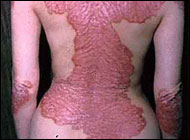
About 300 000 Swedes suffer from the difficult to treat disease, which manifests itself in scaly and often itchy patches on the skin. The reason is that cells divide without restraint as new blood vessels form in the deeper layers of the skin.
An important component is the psoriasin protein (S100A7), which are abundant in psoriasis-affected skin but rarely in normal skin. The same protein is also assumed to be a factor in the development of breast cancer. The research team, led by associate professor Charlotta Enerbäck, have now illustrated that, in a study on cultured skin cells, the interaction between psoriasin, oxygen free radicals and vascular endothelial growth factors (VEGF) leads to significantly increased cell division and growth of new blood vessels (angiogenesis). When we blocked the formation of psoriasin, the expression of VEGF also decreased.
Published in the journal Breast Cancer Research and Treatment, the results open new possibilities for the effective treatment of this crippling disease.
“We want to examine the ability of psoriasin as a target for therapy. By inhibiting psoriasin, we believe we can reduce vascular formation and thus the proliferation of the disease’s magnitude and intensity,” says Charlotta Enerbäck.
Previous studies in mice have shown that angiogenesis inhibitors reduce not only neovascularization but also inflammation and excessive cell division. Attempts to inhibit the growth factor VEGF have resulted in unwanted side effects because it exists in normal tissue where it contributes to wound healing.
“Since psoriasin expresses itself specifically only in the diseased psoriatic skin, we expect that inhibitors against this are highly selective and effective against the disease, and that the risk for side effects is minimal,” says Charlotta Enerbäck.
Presently, palliative treatments with vitamin D, cortisone, light and low doses of chemotherapy are used. More recently, some "biological", antibody-based drugs arrived on the market, however they are very expensive and not free from side effects.
The study was supported by grants from the
Swedish Cancer Society
The Swedish Psoriasis Association
The Assar Gabrielsson Foundation
The Welander Foundation
The Tore Nilsson Foundation
Article:
Psoriasin (S100A7) Increases the Expression of ROS and VEGF and Acts through RAGE to Promote endothelial cell proliferation by Emman Shubbar, Jenny Vegfors, Mary Carlström, Stina Petersson and Charlotta Enerbäck. Breast Cancer Research and Treatment online 21 December 2011.
Contact:
Charlotta Enerbäck +46 (0) 101 037 429, +46 (0) 734 607 131
Written and revised by
Gerald Hurowitz, M.D.
Our doctors write and review articles for accuracy and keep them up to date.
health.am provides general information, not medical advice. Always consult a qualified health professional about your own health.
Explore health topics
More in this topic
Skin, Hair & Beauty → News
New study shows smoking increases risk of psoriasis
Another disease can be added to the list of smoking-related disorders - psoriasis. Researchers have found that smoking increases the risk of developing psoriasis, heavier smoking increases the risk further, and the risk…
30 October 2007
NewsNatural signal holds promise for psoriasis, age-related skin damage
The body may hold a secret to normalizing skin cell growth that is over zealous in psoriasis and non-melanoma skin cancers and too slow in aging and sun-damaged skin, researchers say. Phosphatidylglycerol, a natural…
29 June 2007
NewsTopical therapies show promise for Psoriasis
Psoriasis, a chronic skin condition characterized by thick, red, scaly patches that itch and bleed, not only makes the activities of daily life difficult, but also can affect a person's emotional well being. Psoriasis…
7 March 2006