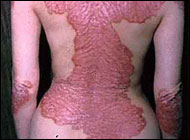
Mice study opens door to psoriasis treatment

Key points
- Researchers said on Sunday they may have discovered what causes psoriasis, a common and irritating skin ailment, and said their findings may open the way to an effective treatment.
- They found that it takes a combination of a protein called STAT3 and an active immune system to cause psoriasis, which experts estimate affects as much as 2 percent of the population.
- Their finding suggests that psoriasis may start with an over-enthusiastic attempt by the body to heal wounds.
- Anderson Cancer Center made a skin cream that blocked the process that leads to psoriasis in mice.
Researchers said on Sunday they may have discovered what causes psoriasis, a common and irritating skin ailment, and said their findings may open the way to an effective treatment.
They found that it takes a combination of a protein called STAT3 and an active immune system to cause psoriasis, which experts estimate affects as much as 2 percent of the population.
Their finding suggests that psoriasis may start with an over-enthusiastic attempt by the body to heal wounds.
And the researchers at The University of Texas M. D. Anderson Cancer Center made a skin cream that blocked the process that leads to psoriasis in mice.
"We may have found an entirely new treatment option for psoriasis," said M.D. Anderson's John DiGiovanni, who led the study.
"We have developed a mouse model that exhibits all the major features of human psoriatic lesions and shown we can reverse those steps."
Psoriasis is a chronic condition in which patches of skin become inflamed and become itchy, red and flaky. There is no good treatment, although symptoms can be alleviated.
The disease involves skin cells called keratinocytes that grow too fast and too abundantly.
"There has been an ongoing controversy about whether the primary defect in psoriasis is in the immune system or in the keratinocytes," DiGiovanni said in a statement.
"We may have found the link - the change in keratinocytes that cooperates with the immune system cells necessary for development of human psoriasis."
Writing in the journal Nature Medicine, the researchers said they looked at STAT3, a protein involved in wound healing and the development of skin cancer.
Activated STAT3 is essential for wound healing. When the healing process is complete, normal STAT3 returns to its inactive form. But when it fails to turn off, the wound healing process continues and skin cells proliferate.
DiGiovanni's team first looked for activated STAT3 in the skin of psoriasis patients and found high levels of activated STAT3 in psoriasis lesions in 19 of 21 of them.
They bred a mouse in which STAT3 is always turned on in the keratinocyte skin cells, and these mice always developed psoriasis.
The researchers then developed a solution containing a small piece of DNA called an oligonucleotide, which was designed to prevent STAT3 from activating genes.
It helped clear up the lesions in the mice.
"This study opens the door to a whole new kind of therapy for psoriasis," said DiGiovanni.
SOURCE: Nature Medicine, December 13, 2004.
Written and revised by
Andrey Nailor, M.D.
Our doctors write and review articles for accuracy and keep them up to date.
health.am provides general information, not medical advice. Always consult a qualified health professional about your own health.
Explore health topics
More in this topic
Skin, Hair & Beauty →NewsDermatology Team Finds Treatment for Rare "Life-ruining" Condition
Dalhousie Medical School dermatologist Dr. Barrie Ross and his colleagues have successfully ended a 20-year quest to find a treatment for Familial Cold Autoinflammatory Syndrome (FCAS). The rare condition, triggered by…
12 March 2008
NewsNew study shows smoking increases risk of psoriasis
Another disease can be added to the list of smoking-related disorders - psoriasis. Researchers have found that smoking increases the risk of developing psoriasis, heavier smoking increases the risk further, and the risk…
30 October 2007
 News
Natural signal holds promise for psoriasis, age-related skin damage
The body may hold a secret to normalizing skin cell growth that is over zealous in psoriasis and non-melanoma skin cancers and too slow in aging and sun-damaged skin, researchers say. Phosphatidylglycerol, a natural…