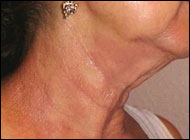
Cosmetic treatment can open the door to bacteria

Key points
- Many people have 'fillers' injected into their facial tissue to give them 'bee-stung lips' or to smooth out their wrinkles.
- According to the American Society for Aesthetic Plastic Surgery (ASAPS), treatment with products based on hyaluronic acid – such as Restylane – constitutes the second-most popular non-surgical cosmetic procedure in the United States.
- Researchers estimate that between 1:100 and 1:1000 - depending on the type of filler -develops an unfortunate bacterial infection which, in the worst-case scenario, may leave the person in question with a permanently disfigured face.
- Injections of fillers were previously reserved exclusively for trauma treatment - when rebuilding a face disfigured in a traffic accident, for example.
Many people have 'fillers' injected into their facial tissue to give them 'bee-stung lips' or to smooth out their wrinkles. Unfortunately, a lot of cosmetic treatment customers experience unpleasant side effects in the form of tender subcutaneous lumps that are difficult to treat and which - in isolated cases - have led to lesions that simply will not heal. Research recently published by the University of Copenhagen now supports that, despite the highest levels of hygiene, this unwanted side effect is caused by bacterial infection.
Injections of fillers were previously reserved exclusively for trauma treatment - when rebuilding a face disfigured in a traffic accident, for example. However, the jelly-like substances are increasingly being used in beauty treatments with the intention of making lips swell up and to erase the effects of ageing from the skin. Side effects in the form of stubborn, tender lumps or even lesions are becoming an increasing problem:
“Previously, most experts believed that the side effects were caused by an auto-immune or allergic reaction to the gel injected. Research involving tissue from patients and mouse models has now shown that the disfiguring lesions are actually due to bacteria injected in connection with the cosmetic procedure. What is more, we have demonstrated that the fillers themselves act as incubators for infection, and all it takes is as few as ten bacteria to create an ugly lesion and a tough film of bacterial material – known as biofilm – which is impossible to treat with antibiotics,” says Morten Alhede, a postdoc at the Department of International Health, Immunology and Microbiology, University of Copenhagen.
Biofilm is resistant to antibiotics
Treatment with fillers is very common. According to the American Society for Aesthetic Plastic Surgery (ASAPS), treatment with products based on hyaluronic acid – such as Restylane – constitutes the second-most popular non-surgical cosmetic procedure in the United States. The precise figures for Denmark are not known, but there can be no doubt that the numbers are rising rapidly – and a rise in the number of treatments will inevitably make the side effects more evident.
"Because a lot of cosmetic practitioners refuse to accept that side effects from filler procedures are caused by bacteria, claiming that such problems are caused by allergic reactions, the usual procedure has been to treat with steroids. This is actually the worst possible treatment because steroid injections exacerbate the condition and give the bacteria free rein. Fortunately, many of the filler producers have now become aware of the risk of bacteria and recognise that the gel can act as a bacterial incubator,” says Associate Professor Thomas Bjarnsholt from the Department of International Health, Immunology and Microbiology. He continues:
“The problem will become very serious when the treatment becomes so widespread that people are able to walk in off the street to have their wrinkles smoothed out. Experts recommend keeping facial skin free from make-up for a month before undergoing a treatment involving fillers. Good hygiene is always important. Even when you abide by all the rules and regulations, it is difficult to avoid bacteria completely as they are often buried far below the surface of the skin.”
Written and revised by
Gerald Hurowitz, M.D.
Our doctors write and review articles for accuracy and keep them up to date.
health.am provides general information, not medical advice. Always consult a qualified health professional about your own health.
Explore health topics
More in this topic
Skin, Hair & Beauty → Guide
Treatment overview
Teenagers and many others with acne, seek five-minute cures for acne and a return to a clear skin free of blemishes. The truth is that there are no instant cures, but a twice daily routine and appropriate treatment…
26 April 2005
GuideAcne Scarring: Treatment options
Treatment options The internet will bombard you with thousands of miracle cures for acne scars, but if you are searching for a solution that won't leave you looking like Michael Jackson, read the following options and…
26 April 2005
GuideAcne bacteria genome decoded
European scientists have sequenced the complete genome of a bacterial species involved in many cases of acne, and they're already working on potential new treatments based on that achievement. "We have identified this…
26 April 2005