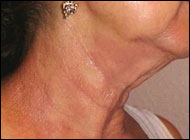
Plaque Psoriasis
Key points
- It typically appears as thick, flaky patches of skin on one or more parts of the body.
- This type of psoriasis most often affects children and young adults.
- The palms and soles can also be affected by pustular psoriasis.
- Commonly affected sites are the elbows, knees, knuckles, scalp, trunk, arms and legs, and external sex organs.
This is the most common type of psoriasis. It typically appears as thick, flaky patches of skin on one or more parts of the body. Sometimes the patches of affected skin are large, extending over much of the body. The patches, known as plaques or lesions, can wax and wane but tend to be chronic.
Plaque psoriasis can occur anywhere on the body. Commonly affected sites are the elbows, knees, knuckles, scalp, trunk, arms and legs, and external sex organs. The plaques do not always itch, but when scratched they can become inflamed. This is known as the Koebner phenomenon.
Guttate Psoriasis
This type of psoriasis most often affects children and young adults. It appears as small, red bumps-the size of drops of water-on the skin. It usually appears suddenly, often several weeks after an infection such as strep throat.
Antibiotics may be used to treat guttate psoriasis that is triggered by an infection. Guttate psoriasis usually responds to treatment and may gradually go away on its own. Many people who have an episode of guttate psoriasis may not have another one for many years.
In adults who have plaque psoriasis, the appearance of the small droplike bumps of guttate psoriasis can be a sign that the disease is flaring up.
Psoriasis Of Special Skin Sites
- Psoriasis that affects the scalp is called seborrheic psoriasis. The scalp may be the first site to be affected by psoriasis. The condition may resemble severe dandruff. Patches of thick, flaky skin may extend to the forehead below the hairline. Scales may build up in the outer ear. Other than the forehead and the ears, the face is usually spared. However, some people may have patches of inflamed skin that resemble seborrheic dermatitis, a type of dandruff eczema that affects the scalp and face.
- Psoriasis can affect the connective tissue that forms the nails. Pitting of the nails may be an early sign of nail psoriasis, although pitting can also occur in other diseases. Other signs of nail psoriasis include the appearance of dark spots resembling oil droplets on the nails, the build-up of flaky skin cells under the nails, and separation or loosening of the nails from their beds (onycholysis). One or more nails may be affected.
- Psoriasis that affects the palms of the hands and the soles of the feet is called palmoplantar psoriasis. It may appear as chronic flaky patches that crack and bleed. The nails may be affected as well. In severe cases the condition can be disabling.
The palms and soles can also be affected by pustular psoriasis. In this condition small, deep, pus-filled blisters appear on the palms and soles. They may have a copper-colored hue on a background of red, flaky skin. This condition may also be called palmoplantar pustulosis or acropustulosis.
Written and revised by
Gerald Hurowitz, M.D.
Our doctors write and review articles for accuracy and keep them up to date.
health.am provides general information, not medical advice. Always consult a qualified health professional about your own health.
Explore health topics
More in this topic
Skin, Hair & Beauty →NewsPsoriasis my yield to modified anti-anxiety drug
A new benzodiazepine derivative, called Bz-423, holds promise for treating psoriasis without being toxic to normal cells, a research team at the University of Michigan in Ann Arbor reports. Psoriasis is a scaly skin…
17 December 2004
 News
Mice study opens door to psoriasis treatment
Researchers said on Sunday they may have discovered what causes psoriasis, a common and irritating skin ailment, and said their findings may open the way to an effective treatment. They found that it takes a combination…
13 December 2004
NewsImmune drugs useful for psoriasis
New research shows that tacrolimus ointment and pimecrolimus cream, which suppress the immune system, are effective treatments for intertriginous psoriasis, a form of the scaly skin disease affecting body regions where…
30 November 2004