What Drives Brain Changes in Macular Degeneration?
Key points
- In macular degeneration, the most common form of adult blindness, patients progressively lose vision in the center of their visual field, thereby depriving the corresponding part of the visual cortex of input.
- The McGovern Institute for Brain Research at MIT is led by a team of world-renowned neuroscientists committed to meeting two great challenges of modern science: understanding how the brain works and discovering new ways to prevent or treat brain disorders.
- Just how such plasticity occurred was unknown, but a new MIT study sheds light on the underlying neural mechanism.
- “This study shows us one way that the brain changes when its inputs change.
In macular degeneration, the most common form of adult blindness, patients progressively lose vision in the center of their visual field, thereby depriving the corresponding part of the visual cortex of input. Previously, researchers discovered that the deprived neurons begin responding to visual input from another spot on the retina — evidence of plasticity in the adult cortex.
Just how such plasticity occurred was unknown, but a new MIT study sheds light on the underlying neural mechanism.
“This study shows us one way that the brain changes when its inputs change. Neurons seem to ‘want’ to receive input: when their usual input disappears, they start responding to the next best thing,” said Nancy Kanwisher of the McGovern Institute for Brain Research at MIT and senior author of the study appearing in the March 4 issue of the Journal of Neuroscience.
“Our study shows that the changes we see in neural response in people with MD are probably driven by the lack of input to a population of neurons, not by a change in visual information processing strategy,” said Kanwisher, the Ellen Swallow Richards Professor of Cognitive Neuroscience in MIT’s Department of Brain and Cognitive Sciences.
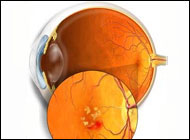
Macular degeneration affects 1.75 million people in the United States alone. Loss of vision begins in the fovea of the retina — the central area providing high acuity vision that we use for reading and other visually demanding tasks. Patients typically compensate by using an adjacent patch of undamaged retina. This “preferred retinal locus” (PRL) is often below the blind region in the visual field, leading patients to roll their eyes upward to look at someone’s face, for example.
The visual cortex has a map of the visual field on the retina, and in macular degeneration the neurons mapping to the fovea no longer receive input. But several labs, including Kanwisher’s, previously found that the neurons in the visual cortex that once responded only to input from central vision begin responding to stimuli at the PRL. In other words, the visual map has reorganized.
“We wanted to know if the chronic, prior use of the PRL causes the cortical change that we had observed in the past, according to what we call the use-dependent hypothesis,” said first author Daniel D. Dilks, a postdoctoral fellow in the Kanwisher lab. “Or, do the deprived neurons respond to stimulation at any peripheral location, regardless of prior visual behavior, according to the use-independent hypothesis?”
The previous studies could not answer this question because they had only tested patients’ PRL. This new study tests both the PRL and another peripheral location, using functional magnetic resonance imaging (fMRI) to scan two macular degeneration patients who had no central vision, and consequently had a deprived central visual cortex.
Because patients habitually use the PRL like a new fovea, it could be that the deprived cortex might respond preferentially to this location.
Written and revised by
Andrey Nailor, M.D.
Our doctors write and review articles for accuracy and keep them up to date.
health.am provides general information, not medical advice. Always consult a qualified health professional about your own health.
Explore health topics
More in this topic
Eyes, Ears & Teeth →A Look at the Future of Age-Related Macular Degeneration (AMD) Treatment
Two particularly notable research presentations at the American Academy of Ophthalmology’s Annual Meeting described new approaches to the treatment of “wet” Age-Related Macular Degeneration (AMD), the most common cause…
13 November 2007