
A little Mozart might benefit preemies' growth
Key points
- The sounds of Mozart might help slow premature infants' metabolism, potentially helping them to put on needed weight, a study published Monday suggests.
- Most research into the so-called "Mozart effect" has focused on whether listening to the composer can boost a person's IQ.
- But there is also evidence that music, more generally, may have benefits for premature infants - including better weight gain and growth.
- In the new study, Israeli researchers looked at the potential effects of Mozart on 20 premature infants' resting metabolism, based on the premise that lower metabolism might explain the increased weight gain studies have attributed to music.
The sounds of Mozart might help slow premature infants' metabolism, potentially helping them to put on needed weight, a study published Monday suggests.
Most research into the so-called "Mozart effect" has focused on whether listening to the composer can boost a person's IQ. A 1993 study of 36 college students found that listening to a Mozart sonata appeared to temporarily boost performance on a test of spatial- temporal reasoning - measured by participants' ability to make cuts in a folded paper while visualizing what the final results would be when the paper was unfolded.
But there is also evidence that music, more generally, may have benefits for premature infants - including better weight gain and growth.
In the new study, Israeli researchers looked at the potential effects of Mozart on 20 premature infants' resting metabolism, based on the premise that lower metabolism might explain the increased weight gain studies have attributed to music.
They found that, on average, the infants' metabolism slowed by up to 13 percent within 10 to 30 minutes of listening to a "Baby Mozart" CD.
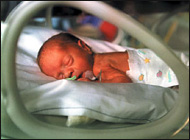
The findings support the theory that music might help preemies gain weight, according to the researchers, led by Dr. Ronit Lubetzky of Tel Aviv Sourasky Medical Center. However, the team did not directly measure the infants' weights.
Also still unclear is whether the study has detected a "Mozart effect" or a potential benefit of music in general, the researchers note in their report, published in the journal Pediatrics.
They do, however, point to a previous study of adults with seizures that found that compositions by Mozart, more so than other classical composers, appeared to lower seizure frequency. It's possible, according to Lubetzky's team, that the proposed Mozart effect on the brain is related to the structure of his compositions.
Compared with other famous composers, they explain, Mozart's music tends to repeat the melodic line more frequently. Other researchers have speculated that this more-organized musical structure may have greater resonance for the brain.
If this is true, Lubetzky's team writes, it would be "fascinating" to study whether it is also the case for preterm infants' immature brains.

The findings are based on 20 premature but healthy infants who were one month old, on average. The researchers measured the babies' resting metabolism as the infants listened to 30 minutes of Mozart on two consecutive days; for comparison they also measured the infants' metabolism during 30 minutes of silence on another two consecutive days.
Written and revised by
Andrey Nailor, M.D.
Our doctors write and review articles for accuracy and keep them up to date.
health.am provides general information, not medical advice. Always consult a qualified health professional about your own health.
Explore health topics
More in this topic
Children's Health → News
When moms get flu shot, babies benefit too: study
When pregnant women get vaccinated against flu, their babies are bigger, healthier and less likely to be premature, researchers reported on Thursday. The studies show that influenza vaccines protect not only women, who…
31 October 2009
 News
Why are preemies more likely to develop autism?
Researchers have long seen signs of autism in children born prematurely, and some studies have suggested that such signs can develop into full-blown autism in childhood. A study out Monday suggests that complications…
21 October 2009
 News
Benefits of adenotonsillectomy persist in kids
In children with sleep-related breathing disorders, removing the tonsils and adenoids - an operation called adenotonsillectomy - is apt to yield long-lasting improvements in sleep and behavior, doctors from Kansas City…

