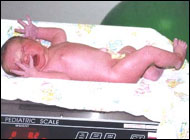
Preemies at high risk of autism don't show typical signs of disorder in early infancy

Key points
- Premature babies are at an increased risk for developing autism spectrum disorder.
- The research is available in the July/August issue of The American Journal of Occupational Therapy.
- Early intervention can benefit children with autism spectrum disorder.
- In the new study, the researchers observed behavioral symptoms characteristic of autism in a particularly high-risk group of young children: those born prematurely.
Premature babies are at an increased risk for developing autism spectrum disorder. But a small study indicates that preemies who avoid eye contact in early infancy are less likely to demonstrate symptoms of autism at age 2 than preemies who maintain eye contact during early interactions, according to new research at Washington University School of Medicine in St. Louis.
"Children with autism typically have challenges with social interaction and may avoid eye contact, but it turned out that children in this study who had characteristics of autism at age 2 were more likely to maintain eye contact and not avert their gazes in early infancy," said first author Bobbi Pineda, PhD, assistant professor in occupational therapy and in pediatrics.
The research is available in the July/August issue of The American Journal of Occupational Therapy.
Early intervention can benefit children with autism spectrum disorder. However, while signs of autism have been observed in infants as early as two to six months of age, the disorder is difficult to diagnose before age 2.
In the new study, the researchers observed behavioral symptoms characteristic of autism in a particularly high-risk group of young children: those born prematurely. Observing early behaviors may give researchers and clinicians indicators to look for early in life so they can recommend timely diagnostic testing and interventions to improve a baby's adaptive responses and outcome.
The researchers evaluated 62 premature infants hospitalized in the neonatal intensive care unit (NICU) at St. Louis Children's Hospital. The infants were born at least 10 weeks before they reached full term and were evaluated close to the dates they were supposed to have been born.
The researchers focused on whether the infants made eye contact or averted their gazes; responded to objects or people around them; interacted socially; and calmed themselves when upset. They also looked at whether the babies exhibited a horizontal repetitive eye movement called nystagmus.
Of the 62 preemies, 58 were observed for visual cues; the others were asleep during visits from the researchers. Of those 58 babies, 41 averted their gazes, and 21 showed nystagmus. Nearly all of the infants with nystagmus -- 19 -- also averted their gazes.
When the babies in the study were screened for autism at age 2, using a recognized screening checklist for autism in toddlers, 13 - or 21 percent - screened positive. A positive finding indicates a child is at risk and should receive diagnostic testing. The researchers were surprised to find that many of the babies who had averted their gazes and showed signs of nystagmus as infants did not display warning signs of autism at age 2.
"Surprisingly, we found that the children who later screened positive for autism were more likely as infants to not avert their gazes during social interaction," Pineda said. "They were more likely to sustain eye contact."
Written and revised by
Gerald Hurowitz, M.D.
Our doctors write and review articles for accuracy and keep them up to date.
health.am provides general information, not medical advice. Always consult a qualified health professional about your own health.
Explore health topics
More in this topic
Children's Health → News
After puberty, girls at higher risk of insomnia
Adolescent girls appear to be at greater risk of insomnia after they begin menstruation, a study has found, suggesting that hormonal changes play a role in some girls' development of the sleep disorder. Researchers…
15 February 2006
 News
Girls abused by dates at higher STD risk
Adolescent girls who have been shoved, hit, forced into any sexual activity or otherwise physically or sexually abused by a date are more likely than their non-abused peers to have been tested for a sexually transmitted…
2 August 2005
 News
Flu vaccination rate up among high-risk children-CDC
The number of toddlers vaccinated against influenza in the United States has jumped during the current flu season, but fewer older Americans are lining up for the shots, federal officials said on Thursday. The findings,…