Bigger birth weight babies at greater risk of autism

Key points
- The biggest study of fetal growth and autism ever has reported that babies whose growth is at either extreme in the womb, either very small or very large, are at greater risk of developing autism.
- It is the first time that a clear link has been made between babies who grow to above average size at birth and risk of Autism Spectrum Disorder and follows from a study of more than 40,000 child health records in Sweden.
- The research, led by The University of Manchester, also confirms earlier research which reported that premature and poorly grown, low weight babies appear more susceptible to the condition.
- Professor Kathryn Abel, from the University’s Centre for Women’s Mental Health and Institute of Brain, Behaviour and Mental Health, led the research published in The American Journal of Psychiatry this month.
The biggest study of fetal growth and autism ever has reported that babies whose growth is at either extreme in the womb, either very small or very large, are at greater risk of developing autism.
It is the first time that a clear link has been made between babies who grow to above average size at birth and risk of Autism Spectrum Disorder and follows from a study of more than 40,000 child health records in Sweden.
The research, led by The University of Manchester, also confirms earlier research which reported that premature and poorly grown, low weight babies appear more susceptible to the condition.
Autism affects how individuals interact with the world and with other people and there is no known cure. One child in 100 has the condition in the UK according to NHS figures. Researchers believe it has origins in both genetic and environmental causes.
Professor Kathryn Abel, from the University’s Centre for Women’s Mental Health and Institute of Brain, Behaviour and Mental Health, led the research published in The American Journal of Psychiatry this month.
Professor Abel said: “The processes that leads to ASD probably begin during fetal life; signs of the disorder can occur as early as three years of age. Fetal growth is influenced by genetic and non-genetic factors. A detailed understanding of how fetal growth is controlled and the ways in which it is associated with ASD are therefore important if we are to advance the search for cures.
“To our knowledge, this is the first large prospective population-based study to describe the association between the degree of deviance in fetal growth from the normal average in a population of children and risk of ASD with and without intellectual disability. We have shown for the first time categorically that abnormal fetal growth in both directions increases risk of autism spectrum disorder.”
Researchers looked at data from the Stockholm Youth Cohort in Sweden, where early ultrasound dating provides detailed weights of the baby’s progression in pregnancy. Infants and children then also take part in structured clinical assessments of their social, motor, language and cognitive abilities.
The cohort contained records of 589,114 children aged 0-17 in Sweden between 2001 and 2007. Certain child data was removed, including children too young to have a diagnosis for ASD, adopted children and non Swedish or Stockholm County residents, children not born in Sweden and twins.
From the remaining available data, researchers found 4,283 young people with autism and 36,588 who did not have the condition and who acted as the control.
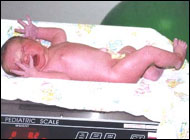
The study found that bigger babies who were born weighing over 4.5kg (or 9lb 14) showed a higher incidence of autism, as did smaller infants who were born weighing less than 2.5kg (5.5lb). A baby who had poor fetal growth would therefore have a 63% greater risk of developing autism compared to normally grown babies. A baby who was large at birth would have a 60% greater risk. This effect was independent of whether or not the baby was born pre or post term.
Written and revised by
David Cohen, M.D.
Our doctors write and review articles for accuracy and keep them up to date.
health.am provides general information, not medical advice. Always consult a qualified health professional about your own health.
Explore health topics
More in this topic
Children's Health → News
In study, new swab reveals one-third of babies with severe diarrhea had undiagnosed, treatable infection
With Canadian government funding, medical scientists have created and demonstrated a new tool that could dramatically lower the tragic annual toll of 760,000 infants and children killed, and millions more stunted, due…
26 May 2015
 News
Promoting maternal interaction improves growth, weight gain in preemies
An intervention to teach mothers of preterm infants how to interact with their babies more effectively results in better weight gain and growth for the infants, according to a study funded in part by the National…
31 March 2015
 News
Five babies at suburban Chicago daycare center have measles
Five babies at a suburban Chicago daycare center have been diagnosed with measles, adding to a growing outbreak of the disease across the United States, Illinois health officials said on Thursday. Officials are…