
Promoting maternal interaction improves growth, weight gain in preemies

Key points
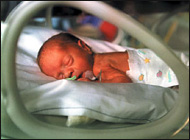
- An intervention to teach mothers of preterm infants how to interact with their babies more effectively results in better weight gain and growth for the infants, according to a study funded in part by the National Institutes of Health.
- A subsequent study showed that infants who had the benefit of a major component of this intervention more rapidly developed the muscle control needed for feeding successfully from a bottle.
- Briefly, the intervention involved teaching mothers to recognize and respond to the subtle cues their preterm infants were hungry - far less pronounced than term infants.
- Infants born preterm often are not developed enough to feed on their own.
An intervention to teach mothers of preterm infants how to interact with their babies more effectively results in better weight gain and growth for the infants, according to a study funded in part by the National Institutes of Health.
A subsequent study showed that infants who had the benefit of a major component of this intervention more rapidly developed the muscle control needed for feeding successfully from a bottle. The initial findings were published on line in the Journal of Perinatology and the subsequent study in Advances in Neonatal Care.
Briefly, the intervention involved teaching mothers to recognize and respond to the subtle cues their preterm infants were hungry - far less pronounced than term infants. Mothers were also taught how to provide appropriate social and physical stimulation - such as soothing talk, and gentle massages - to spur their infants' neurological development.
Infants born preterm often are not developed enough to feed on their own. Typically, the muscle control needed for infants to feed unassisted does not completely develop until the 34th week of pregnancy. Infants born before this time usually are fed through a nasogastric tube - a line passed through the nose and down the throat into the stomach.
The study authors developed the intervention to help mothers stimulate their infant's alertness before feeding so that the infants would be better able to feed by mouth. The intervention also sought to spur the infants' social behaviors, such as keeping alert and looking at the mother, and neurological development, in hopes of offsetting at least some of the developmental delays often seen in preterm infants.
"Preterm infants who fail to gain sufficient weight are at a higher risk for delays and even impairments in cognitive ability and motor skills," said Valerie Maholmes, Ph.D., chief of the Pediatric Trauma and Critical Illness Branch at the NIH's Eunice Kennedy Shriver National Institute of Child Health and Human Development, which funded the research. "We are hopeful that this intervention will prove to be an important tool in safeguarding the long-term health of an extremely vulnerable group of infants."
Additional funding for the research was provided by the National Institute of Nursing Research, also at NIH.
The study was conducted by Rosemary C. White-Traut, Ph.D, R.N., and colleagues at the University of Illinois, Mercy Hospital and Medical Center, and Sinai Hospital Medical Center, all in Chicago. Dr. White-Traut is now at Children's Hospital of Wisconsin in Milwaukee.
During their first year, infants born preterm are at high risk for life-threatening infections, blindness, breathing problems, feeding problems, learning and developmental disabilities, and cerebral palsy. According to the U.S. Centers for Disease Control and Prevention, nearly 500,000 U.S. infants were born preterm in 2013, the most recent year for which statistics are available. Roughly 11 percent of births to Hispanics were preterm. The study authors write that it is common for preterm infants to grow more slowly than normal. Infants who grow at an appropriate rate have the best chances for avoiding problems in their neurological development.
Written and revised by
David Cohen, M.D.
Our doctors write and review articles for accuracy and keep them up to date.
health.am provides general information, not medical advice. Always consult a qualified health professional about your own health.
Explore health topics
More in this topic
Children's Health → News
Maternal obesity predisposes baby to Alzheimer's
Maternal obesity causes cellular programming in utero that predisposes offspring to inflammation-related disorders, such as Alzheimer's, Parkinson's, type 2 diabetes, stroke, heart disease, from the day that they are…
11 February 2010
 News
Growth hormone therapy more common in boys
Boys who are short due to underlying health problems are more likely than their female counterparts to be treated with growth hormone - but the gap is not explained by a bias in doctors' recommendations for treatment, a…
4 February 2010
 News
A little Mozart might benefit preemies' growth
The sounds of Mozart might help slow premature infants' metabolism, potentially helping them to put on needed weight, a study published Monday suggests. Most research into the so-called "Mozart effect" has focused on…


