Biology and Natural History of Breast Cancer in the Elderly
Key points
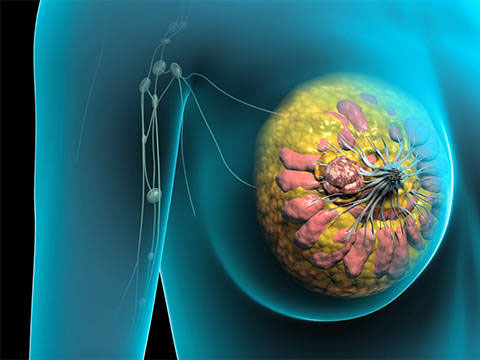
- The dense fibrous and glandular breast tissue of early adulthood is replaced by increasing amounts of fat as a woman ages.
- Numerous studies have examined the relationship between age and extent of disease at time of breast cancer diagnosis.
- The largest database is from the SEER program, which includes more than 125,000 women with breast cancer (Table 33.3).
- Although there is little evidence that biologic differences in tumor or host account for stage differences in older and younger patients at presentation, there is evidence that patient/physician behavior surrounding the diagnostic process is different for older women.
Normal breast tissue changes with age. The dense fibrous and glandular breast tissue of early adulthood is replaced by increasing amounts of fat as a woman ages. After menopause, there is further involution of the glandular structures. The fatty replacement simplifies mammographic screening in older women as there is better contrast between the density of a malignancy and the density of fatty tissue. With aging, there is also a decreased tendency to develop benign breast lesions. The breast nodularity or fibrocystic change, occurring in response to cyclic hormonal changes in premenopausal women, rarely occurs in postmenopausal women unless they are receiving hormone replacement therapy. Gross cysts, which occur most commonly in women during the 15 years before menopause, are rare in the elderly. Fibroadenomas, most common between the ages of 20 and 35, are also rare in postmenopausal women. For these reasons, most newly developing breast masses in postmenopausal women are carcinomas.
Numerous studies have examined the relationship between age and extent of disease at time of breast cancer diagnosis. Stage at diagnosis is determined by two sets of factors: (1) tumor/host biology; and (2) patient/physician behavior surrounding the diagnostic process. Several studies have noted that older women have a higher likelihood of presenting with advanced disease.
The largest database is from the SEER program, which includes more than 125,000 women with breast cancer (Table 33.3). These data indicate that a greater proportion of elderly women present with distant disease, although a smaller proportion present with regional disease. The proportion of patients who present with localized disease does not vary with age and remains about half in all age groups.
Although there is little evidence that biologic differences in tumor or host account for stage differences in older and younger patients at presentation, there is evidence that patient/physician behavior surrounding the diagnostic process is different for older women. Older women are less likely to practice breast self-examination, obtain regular breast examinations from their physicians, or undergo screening mammography. Samet et al. conducted a population-based study of 194 women with breast cancer, 65 years or older at diagnosis, to examine factors associated with stage at presentation. Factors associated with an advanced stage at presentation included longer delay between initial symptom and seeking medical care, older age, absence of breast self-examination, and poor performance on a short test of knowledge about cancer. Of the women who were symptomatic at time of diagnosis, 29% had delay of at least 3 months between symptom onset and seeking medical care. Delay in seeking care was associated with a lack of social support, a relatively common problem among the elderly.
Established prognostic factors for localized breast cancer include number of involved axillary lymph nodes, size of the primary tumor, tumor histologic and nuclear grade, lymphatic and vascular channel invasion, estrogen and progesterone receptor status, Her-2/neu overexpression, and measures of tumor proliferation such as mitotic index, Ki-67, and percent of cells in S phase of the cell cycle (). In general, poor prognostic factors are less common in breast cancers of older women. Information from several large databases indicates that older women with localized disease have a higher proportion of estrogen and progesterone receptor-positive tumors and a lower incidence of Her-2/neu overexpression. The tumors of elderly women are more likely to be lower grade and have lower breast cancer cell proliferation rates. Several groups have reported an increased proportion of mucinous and papillary carcinomas, histologic subtypes with a favorable prognosis, among older women. These subtypes still account for less than 10% of breast cancers in older women, and the most common subtype in both older and younger women is infiltrating ductal carcinoma.
Written and revised by
David Cohen, M.D.
Our doctors write and review articles for accuracy and keep them up to date.
health.am provides general information, not medical advice. Always consult a qualified health professional about your own health.
Explore health topics
More in this topic
Cancer → News
T cells that recognize HER2 teceptor may prevent HER2+ breast cancer recurrence
Recurrence of HER2-positive breast cancer after treatment may be due to a specific and possibly cancer-induced weakness in the patient's immune system - a weakness that in principle could be corrected with a…
31 December 2015
 News
New breast cancer drug may be effective against other types of cancer
Palbociclib, a new oral drug whose efficacy in combating breast cancer has been demonstrated alone and in combination with endocrine therapy, also has potential to combat other types of cancer, according to a literature…
30 December 2015
 News
NYU nursing study examines obesity in relation to breast cancer related lymphedema
Each year, about 1.38 million women worldwide are diagnosed with breast cancer. Advances in treatment have facilitated a 90% five-year survival rate among those treated. Given the increased rate and length of survival…