Gerald Hurowitz, M.D.·Published 22 November 2010·7 min read
Key points
Prevention, especially in young people, is universally viewed as the best approach to reverse the rising global prevalence of obesity.
Prevention measures can be instituted at individual, household, institutional, community, and health-care levels.
So far, no intervention studies have examined the long-term effect of reduction of gestational diabetes or maternal adiposity on future obesity risk in offspring.
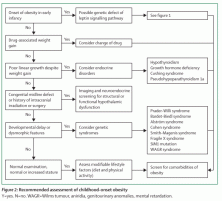
Figure 2: Recommended assessment of childhood-onset obesity Y=yes.
Prevention, especially in young people, is universally viewed as the best approach to reverse the rising global prevalence of obesity. However, evidence about the most effective means of prevention of obesity development in children is scarce. Many prevention trials have had sample sizes too small for expected effect size or insuficient length of follow-up. Some trials have also been criticised for not being based on sound theories of behavioural change and for having inadequate feasibility and pilot work.87
Trials of prevention interventions might also have failed to show notable effects because they did not adequately address the energy gap88 separating children who remain lean from those who gain weight throughout childhood.89 Butte and Ellis90 calculated that an energy deficit of more than 250 kcal per day is needed to prevent further weight gain in 90% of overweight children; this deficit is equivalent to a child walking an additional 1-2 h per day at 1·9 km/h, or consuming roughly a fifth fewer calories than usual per day.
Prevention measures can be instituted at individual, household, institutional, community, and health-care levels. At the individual level, carers should be targeted rather than young children themselves, and focus on mothers seems reasonable. First, developmental or fetal overnutrition as a result of gestational diabetes or maternal obesity might have contributed to the obesity epidemic.
So far, no intervention studies have examined the long-term effect of reduction of gestational diabetes or maternal adiposity on future obesity risk in offspring. Second, breastfeeding might prevent childhood obesity. However, results of systematic reviews suggest that observational associations could be accounted for largely by residual confounding or publication bias, and in a large randomised trial of a breastfeeding promotion intervention, no causal effect of breastfeeding on obesity risk was reported.91
Third, mothers might influence diets of offspring more than do fathers;92 however, no intervention trials of maternal-only interventions to prevent childhood obesity have been done.
At a household or family level, encouragement of parents to offer appropriate food portions, foster physical activity, increase activities of daily living, and keep sedentary behaviours to a minimum are viewed as basic measures of prevention.93 Most government guidelines have traditionally focused on ensuring that nutritional intake is adequate.
Written and revised by
Gerald Hurowitz, M.D.
Our doctors write and review articles for accuracy and keep them up to date.
health.am provides general information, not medical advice. Always consult a qualified health professional about your own health.
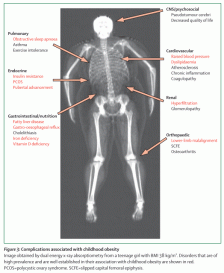
Figure 3: Complications associated with childhood obesity Image obtained by dual energy x-ray absorptiometry from a teenage girl with BMI 38 kg/m². Disorders that are of high prevalence and are well established in their association with childhood obesity are shown in red. PCOS=polycystic ovary syndrome. SCFE=slipped capital femoral epiphysis.
{embed="ref/stat-menu-childhood-obesity"}
However, these guidelines might not be useful to ensure energy intakes that are appropriate for contemporary sedentary lifestyles. We are unaware of any randomised controlled trials focusing solely on household or family-based interventions to prevent childhood obesity.
Most randomised prevention trials have taken place in schools since they are viewed as a universal catchment setting for children. The core features of most prevention programmes are to change the caloric content of school meals and encourage physical activity. One policy that is debated in the USA is removal of vending machines from schools to curb availability of energy-dense snack foods.
However, a US national survey showed that snack foods from vending machines contributed only 1·3% of total daily calories from snacks, whereas snacks at or from home contributed 69·1%.95 At least nine systematic reviews have examined randomised controlled trials of school-based childhood obesity prevention programmes87,96 (see also citations of other systematic reviews within these reports).
Early reviews noted scarce evidence of effectiveness and poor quality of studies, whereas more recent reviews suggested that school-based interventions might be effective. Gonzalez-Suarez and colleagues96 identified 19 high-quality trials of school-based interventions and reported reduced odds of overweight or obesity in intervention compared with control groups (pooled odds ratio 0·74 [95% CI 0·60-0·92]). The key effective characteristics of such programmes remain to be established, and, since most studies were done in the USA, whether they are effective elsewhere. Although initiatives have also been aimed at children in kindergarten or nurseries,97 the few controlled trials in this setting have not yet been systematically reviewed. One area to be addressed is the built environment of schools or nurseries.
{pagebreak}
Architectural designs of school buildings and their environment can be re-examined for opportunities to impose increased energy expenditure. A multi-storey building with purposefully designed class schedules could lead to substantial stair (or ramp) climbing during the school day.
Prevention in the community includes public policies and mass-media campaigns.98,99 For the past decade, pressure has been increasing for labelling of caloric contents on menus, especially at fast-food restaurants.
However, data for the effects of such labelling on prevention of childhood obesity are scarce.100
In 2002, the US Centers for Disease Control and Prevention launched a 2-year marketing campaign via media advertisements to promote physical activity in children aged 9-13 years.101
Children's physical activity (assessed by self-report) increased,98,99 but effects on BMI were not assessed. In several countries, governments are being urged to address the toxic environment by levying taxes on sugared beverages and fast foods, though the effectiveness of such measures is unknown.102
{embed="ref/stat-menu-childhood-obesity"}
Popular media in several countries have given much attention to the topic of obesity, but no objective information is available about the effect of these messages on the public. Public health surveillance and screening for childhood obesity have been implemented in some communities. In 2003, Arkansas was the first US state to pass legislation for mandatory BMI assessments of children in public schools, with yearly reporting to parents. This approach has since been followed in 13 other states.103,104
In 2005, a National Child Measurement Programme was introduced in the UK for yearly surveillance of two school year groups. In 2007, the British Government introduced legislation to give parents the results of their child's measurements.
Existing evidence is unclear as to whether surveillance or screening of childhood obesity will be valuable for prevention.
Infants and young children are seen frequently in medical settings for well-child and acute care. These visits present an opportunity to detect upward deviations in a child's growth rate, thus placing the primary-care provider at the strategic first line of defence before BMI exceeds recommended values. However, data for the effectiveness of such counselling for obesity prevention are scarce. Some crucial periods during childhood present both challenges and windows of opportunity for obesity prevention because they are associated with notable changes in adiposity accrual or obesity-related behaviour. These periods are the first year of life,28 during adiposity rebound (age 3-7 years), and menarche.105 The transition from childhood to adolescence is a time of striking behavioural changes, including an abrupt reduction in physical activity.106 Although whether preventive measures instituted during these times will prevent excessive growth is unclear, these opportunities should be investigated further.
Common sense supports a key role for decreased energy intake and increased energy expenditure in human beings, who have adapted through evolutionary processes to parsimonious energy metabolism. Thus, prevention programmes should decrease energy intake, increase activity, and reduce sedentary behaviour. To balance the need for more definitive research into which interventions best achieve changes in these behaviours against the pressure to act now to halt and reverse the obesity epidemic, we need to continue with both prevention activities and research to better understand the means of induction of behavioural changes and their effect on childhood obesity.
For prevention, one might recall the words of Rudolph Virchow, a 19th century German pathologist, who wrote that ‘‘epidemics appear, and often disappear without traces, when a new culture period has started" and that mass diseases are "due to...disturbances of human culture".107 Geoffrey Rose promulgated the notion further that whole populations can be sick (such as the case of obesity), and that political action might be needed to improve population health.108 Thus, we should continue to seek opportunities for prevention at all levels of society, including having responsible public policies to modify our manner of living, since there remain many untapped resources and untried venues.
###
Joan C Han, Debbie A Lawlor, Sue Y S Kimm
Lancet 2010; 375 - 1737-48 Published Online May 6, 2010 DOI - 10.1016/ S0140- 6736(10)60171-7
Unit on Growth and Obesity, Program on Developmental Endocrinology and Genetics, Eunice Kennedy Shriver National Institute of Child Health and Human Development, National Institutes of Health, DHHS, Bethesda, MD, USA (J C Han MD); MRC Centre for Causal Analyses in Translational Epidemiology, Department of Social Medicine, University of Bristol, Bristol, UK (Prof D A Lawlor PhD); and Department of Internal Medicine/Epidemiology, University of New Mexico School of Medicine, Albuquerque, NM, USA (S Y S Kimm MD)
Correspondence to - Dr Sue Y S Kimm, University of New Mexico Health Sciences Center, Department of Internal Medicine/Epidemiology, University of New Mexico, MSC 10 5550 Albuquerque, NM 87131-0001, USA kimm@pitt.edu
###
REFERENCES
Ebbeling CB, Pawlak DB, Ludwig DS. Childhood obesity: public-health crisis, common sense cure. Lancet 2002; 360: 473-82.
Wang Y, Lobstein T. Worldwide trends in childhood overweight and obesity. Int J Pediatr Obes 2006; 1: 11-25.
Ogden CL, Carroll MD, Flegal KM. High body mass index for age among US children and adolescents, 2003-2006. JAMA 2008; 299: 2401-05.
Kipping RR, Jago R, Lawlor DA. Obesity in children. Part 1: epidemiology, measurement, risk factors, and screening. BMJ 2008; 337: a1824.
Sundblom E, Petzold M, Rasmussen F, Callmer E, Lissner L. Childhood overweight and obesity prevalences levelling off in Stockholm but socioeconomic differences persist. Int J Obes (Lond) 2008; 32: 1525-30.
Cole TJ, Bellizzi MC, Flegal KM, Dietz WH. Establishing a standard definition for child overweight and obesity worldwide: international survey. BMJ 2000; 320: 1240-43.

 News
 News
 News