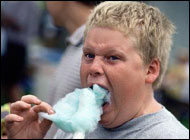
More sleep, less TV fends off child obesity -study

Key points
- Scientists have drawn up a check-list of early warning signs of child Obesity, among them too much television and not enough sleep.
- More than eight hours' TV a week or less than 10-1/2 hours' sleep a night for a three-year-old increase the risk of piling on the pounds, they say.
- "Eight factors in early life are associated with an increased risk of obesity in childhood," said Dr John Reilly, an expert on child obesity at the University of Glasgow.
- The others are: high birth weight; early size; rapid weight gain; quick growth in years one and two; early body fat; and having obese parents.
Scientists have drawn up a check-list of early warning signs of child Obesity, among them too much television and not enough sleep.
More than eight hours' TV a week or less than 10-1/2 hours' sleep a night for a three-year-old increase the risk of piling on the pounds, they say.
"Eight factors in early life are associated with an increased risk of obesity in childhood," said Dr John Reilly, an expert on child obesity at the University of Glasgow. "There are certain factors, very early on, which can set you on a particular path in life to becoming obese," he added in an interview.
The others are: high birth weight; early size; rapid weight gain; quick growth in years one and two; early body fat; and having obese parents.
A propensity to gain weight begins early, even in the womb.
"If you are big early on and you grow rapidly, it seems to predict risk of Obesity later on," said Reilly. "There is something about size and growth, even in the womb, that seems to have an effect."
By the tender age of three, children are developing habits that will mean they are more likely to be overweight or obese.
"We shouldn't be complacent about the lifestyles of our children," Reilly said. "What our study is showing is that although there are early growth risk factors, there are also a number of risk factors that relate to lifestyle, of three-year-olds and probably earlier, that seem to make a difference."
He and his colleagues, whose findings were reported online by the British Medical Journal, studied more than 9,000 children aged seven whose growth had been followed since birth.
Health experts estimate that about 10 percent of children, or at least 155 million youngsters worldwide, are overweight or obese.
Overweight and obese children have a higher risk of suffering from type-2 diabetes and, later in life, of developing Heart disease, Stroke and certain types of cancer.
Reilly stressed that efforts to prevent obesity should begin very early in life.
"We are missing an opportunity to prevent obesity if we do not modify lifestyle and environment early in life. We need to be looking more at improving long-term outcomes by changing lifestyle," he added.
SOURCE: BMJ Online First, May 20, 2005.
Written and revised by
Gerald Hurowitz, M.D.
Our doctors write and review articles for accuracy and keep them up to date.
health.am provides general information, not medical advice. Always consult a qualified health professional about your own health.
Explore health topics
More in this topic
Weight & Nutrition → News
Trauma in Childhood Could Contribute to Obesity in Adults
Scientific studies often attribute obesity to poor nutrition and lack of activity, but recent research has identified childhood traumatic stress as a potential risk factor for obesity in adulthood. The research,…
19 January 2011
 Guide
Pharmacological and surgical treatment of Childhood obesity
A Cochrane review 109 identified ten randomised controlled trials of pharmacological treatments for obese children. Most of these trials had small sample sizes (range 24-539 participants, with 60% including fewer than…
22 November 2010
 Guide
Non-pharmacological treatment of Childhood obesity
We recommend that children with BMI higher than the 95th percentile, or higher than the 85th percentile when accompanied by comorbidities, such as hypertension, hyperlipidaemia, or impaired glucose tolerance, be…