
Family meals, adequate sleep and limited TV may lower childhood obesity

Key points
- A new national study suggests that preschool-aged children are likely to have a lower risk for obesity if they regularly engage in one or more of three specific household routines: eating dinner as a family, getting adequate sleep and limiting their weekday television viewing time.
- In a large sample of the U.S. population, the study showed that 4-year-olds living in homes with all three routines had an almost 40 percent lower prevalence of obesity than did children living in homes that practiced none of these routines.
- Other studies have linked obesity to the individual behaviors of excessive TV viewing, a lack of sleep and, to a lesser extent, a low frequency of family meals.
- The researchers suggested that adopting these three household routines could be an attractive obesity-prevention strategy for all families with young children, especially because these routines may benefit children's overall development.
A new national study suggests that preschool-aged children are likely to have a lower risk for obesity if they regularly engage in one or more of three specific household routines: eating dinner as a family, getting adequate sleep and limiting their weekday television viewing time.
In a large sample of the U.S. population, the study showed that 4-year-olds living in homes with all three routines had an almost 40 percent lower prevalence of obesity than did children living in homes that practiced none of these routines.
Other studies have linked obesity to the individual behaviors of excessive TV viewing, a lack of sleep and, to a lesser extent, a low frequency of family meals. But this is the first study to assess the combination of all three routines with obesity prevalence in a national sample of preschoolers.
The researchers suggested that adopting these three household routines could be an attractive obesity-prevention strategy for all families with young children, especially because these routines may benefit children's overall development. However, they also cautioned that this study alone does not confirm whether the routines themselves, or some other factor, protect children from obesity.
The study appears online and is scheduled for publication in the March issue of the journal Pediatrics.
Each routine on its own was associated with lower obesity, and more routines translated to lower obesity prevalence among 4-year-olds, according to the analysis. The link between the routines and lower obesity prevalence was also seen in children with and without other risk factors for obesity.
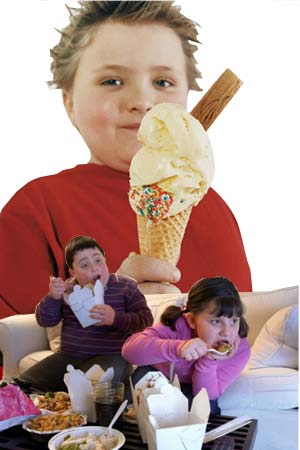
"The routines were protective even among groups that typically have a high risk for obesity. This is important because it suggests that there's a potential for these routines to be useful targets for obesity prevention in all children," said Sarah Anderson, assistant professor of epidemiology at Ohio State University and lead author of the study.
Anderson co-authored the paper with Robert Whitaker, professor of public health and pediatrics at Temple University.
Anderson and Whitaker analyzed data collected in 2005 on 8,550 children who were born in the United States in 2001. The data were collected as part of the Early Childhood Longitudinal Study, Birth Cohort, a study conducted by the National Center for Education Statistics to provide information about learning environments, health and development of young U.S. children.
The researchers examined the association of childhood obesity among preschool-aged children with three household routines: eating the evening meal as a family more than five times per week; obtaining at least 10½ hours of sleep per night; and watching less than two hours per day of TV on weekdays – referred to as "screen-viewing time."
Written and revised by
Andrey Nailor, M.D.
Our doctors write and review articles for accuracy and keep them up to date.
health.am provides general information, not medical advice. Always consult a qualified health professional about your own health.
Explore health topics
More in this topic
Weight & Nutrition → News
Sleep loss from 'social jetlag' tied to obesity
A mismatch between when our internal clock wants us to wake up and when the alarm clock rings to get people to work and school on time could be fuelling obesity, a European study suggests. Tight work schedules and a…
10 May 2012
 News
Obesity raises death risk tied to sleeping pills
Obesity appears to significantly increase the risk of death tied to sleeping pills, nearly doubling the rate of mortality even among those prescribed 18 or fewer pills in a year, researchers reported Friday. "Obesity…
18 March 2012
NewsOverweight people eat fewer meals than others
Normal weight adults, including those who had lost a lot of weight and kept it off, ate more often than overweight people in a new study looking at factors that may help in preventing weight gain. Researchers following…
21 November 2011



