Bipolar disorders
Key points
- The bipolar disorders are bipolar 1 disorder, bipolar II disorder, and cyclothymia.
- Bipolar I disorder is the most serious of the bipolar disorders and is diagnosed after at least one episode of mania (Table 2-3).
- The lifetime prevalence is 0.4% to 1.6% and the male-female ratio is equal.
- Genetic and familial studies reveal that bipolar I disorder is associated with increased bipolar I, bipolar II, and major depressive disorders in first-degree relatives.
The bipolar disorders are bipolar 1 disorder, bipolar II disorder, and cyclothymia.
Bipolar I Disorder
Bipolar I disorder is the most serious of the bipolar disorders and is diagnosed after at least one episode of mania (Table 2-3). Patients with bipolar I disorder typically also have major depressive episodes in the course of their lives.
Epidemiology
The lifetime prevalence is 0.4% to 1.6% and the male-female ratio is equal. There are no racial variations in incidence.
Etiology
Genetic and familial studies reveal that bipolar I disorder is associated with increased bipolar I, bipolar II, and major depressive disorders in first-degree relatives. X linkage has been demonstrated in some studies but remains controversial. Mania can be precipitated by psychosocial stressors, and there is evidence that sleep/wake cycle perturbations may predispose a person to mania.
Clinical Manifestations
History and Mental Status Examination
Bipolar J disorder is defined by the occurrence of mania (or a mixed episode). A single manic episode is sufficient to meet diagnostic requirements; most patients, however, have recurrent episodes of mania typically intermixed with depressive episodes. The criteria for a manic episode are outlined in Table 2-3.
The first episode of mania usually occurs in the early 20s. Manic episodes are typically briefer than depressive episodes. The transition between mania and depression occurs without an intervening period ofeuthymia in abouttwo of three patients (Fig. 2-2A).
Lifetime suicide rates range from 10% to 15%.
Differential Diagnosis
Mania may be induced by antidepressant treatment, including antidepressant medications, psychostimulants, ECT, and phototherapy. When this occurs, the patient is diagnosed with substance-induced mood disorder, not bipolar disorder. Mood disorder due to a general medical condition is the other major differential consideration. Schizo affective disorder, borderline personality disorder, and depression with agitation are also considerations.
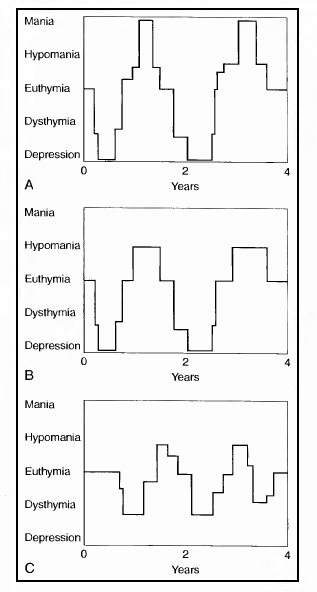
Figure 2-2. Bipolar mood disorders. (A) bipolar I disorder, (B) bipolar II disorder, (C) cyclothymic disorder.
Management
Written and revised by
Andrey Nailor, M.D.
Our doctors write and review articles for accuracy and keep them up to date.
health.am provides general information, not medical advice. Always consult a qualified health professional about your own health.
Explore health topics
More in this topic
Mental Health → News
Study finds difference in way bipolar disorder affects brains of children versus adults
A new study from Bradley Hospital has found that bipolar children have greater activation in the right amygdala – a brain region very important for emotional reaction – than bipolar adults when viewing emotional faces.…
20 June 2014
 News
The real risks of growing up with bipolar parents
Bipolar disorder (BD) is among the 10 most burdensome medical conditions, according to the World Health Organization. The disorder is known for its dramatic highs of extreme euphoria, racing thoughts and decreased need…
11 June 2014
 News
Yale researchers search for earliest roots of psychiatric disorders
Newborns whose mothers were exposed during pregnancy to any one of a variety of environmental stressors - such as trauma, illness, and alcohol or drug abuse - become susceptible to various psychiatric disorders that…