Unipolar disorders
Key points
- Unipolar disorders are major depressive disorder and dysthymic disorder.
- Major depressive disorder is diagnosed after a single episode of major depression (Table 2-2).
- The lifetime prevalence (will occur at some point in a person's life) rate for major depressive disorder is 5% to 20%.
- Psychological theories of depression generally view interpersonal losses (actual or perceived) as risk factors for developing depression.
Unipolar disorders are major depressive disorder and dysthymic disorder.
Major Depressive Disorder
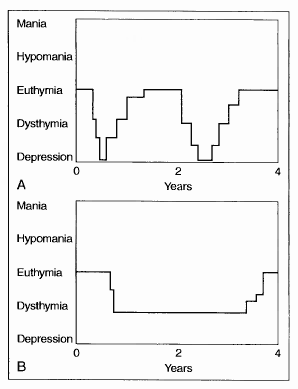
Major depressive disorder is diagnosed after a single episode of major depression (Table 2-2). It is characterized by emotional changes, primarily depressed mood, and by so-called vegetative changes, consisting of alterations in sleep, appetite, and energy levels.
Epidemiology
The lifetime prevalence (will occur at some point in a person's life) rate for major depressive disorder is 5% to 20%. The female-male ratio is 2: 1. Race distributions appear equal, and socioeconomic variables do not seem to be a factor. The incidence (rate of new cases) is greatest between the ages of 20 and 40 and decreases after the age of 65.
Etiology
Psychological theories of depression generally view interpersonal losses (actual or perceived) as risk factors for developing depression. In fact, available evidence suggests that childhood loss of a parent or loss of a spouse are associated with depression.
Classic psychoanalytic theories center on ambivalence toward the lost object (person), although more recent theories focus on the critical importance of the object relationship in maintaining psychic equilibrium and self-regard. The cognitive-behavioral model views cognitive distortions as the primary events that foster a negative misperception of the world, which in turn generate negative emotions. The learned helplessness model (based on animal studies) suggests that depression arises when individuals come to believe they have no control over the stresses and pains that beset them.
Biologic, familial, and genetic data support the idea of a biologic diathesis in the genesis of depression. Genetic studies show that depression is found to be concordant more often in monozygotic twins than in dizygotic twins. Unipolar depression in a parent leads to an increased incidence in the offspring of both unipolar and bipolar mood disorders.
Neurotransmitter evidence points to abnormalities in amine neurotransmitters as mediators of depressive states: The evidence is strongest for deficiencies in norepinephrine and serotonin.
Neuroendocrine abnormalities in the hypothalamic-pituitary-adrenal axis are often present In depression and suggest a neuroendocrine link.
Sleep disturbances are near universal complaints in depressed persons. Objective evidence from sleep studies reveals that deep sleep (delta sleep, stages 3 and 4) is decreased in depression and that rapid-eye-movement (REM) sleep alterations include increased time spent in REM and earlier onset of REM in the sleep cycle (decreased latency to REM).
Clinical Manifestations
Written and revised by
Gerald Hurowitz, M.D.
Our doctors write and review articles for accuracy and keep them up to date.
health.am provides general information, not medical advice. Always consult a qualified health professional about your own health.
Explore health topics
More in this topic
Mental Health → News
Eating disorders often associated with reproductive health problems
According to a Finnish study, women with eating disorders are less likely to have children than others in their age group. The discrepancy is the most apparent in anorexia sufferers. In this group, the number of…
9 October 2013
 News
Sensory illusion study provides new insight for body representation brain disorders
People can be easily tricked into believing an artificial finger is their own, shows a study published today [23 September] in The Journal of Physiology. The results reveal that the brain does not require multiple…
24 September 2013
 News
Alcohol abuse, eating disorders share genetic link
Part of the risk for alcohol dependence is genetic, and the same is true for eating disorders. Now, researchers at Washington University School of Medicine in St. Louis have found it’s likely some of the same genes are…