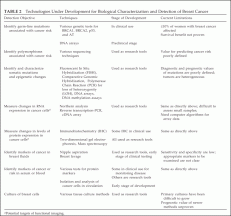
Technologies in Development
Key points
- Most of the progress thus far in the field of breast cancer detection has resulted in incremental improvements in traditional imaging technologies.
- Many consider FFDM to be a major technical advance over traditional mammography, but studies to date have not demonstrated a meaningful improvement in screening accuracy.
- Computer-aided detection, through the use of sophisticated computer programs designed to recognize patterns in images, has also shown potential for improving the accuracy of screening mammography, at least among less experienced readers.
- Other breast imaging technologies approved by the Food and Drug Administration (FDA) include ultrasound, magnetic resonance imaging (MRI), scintimammography, thermography, and electrical impedance imaging (Table 1).
Most of the progress thus far in the field of breast cancer detection has resulted in incremental improvements in traditional imaging technologies. These technical advances have likely led to more consistent detection of early lesions, but clinical trials have not been undertaken to determine whether their use has also resulted in a greater reduction in breast cancer mortality compared with that of older technologies. Many technical improvements have been made to mammography since its initial introduction. One recent example is full-field digital mammography (FFDM). FFDM systems are identical to traditional film-screen mammography (FSM) systems except for the electronic detectors that capture and display the X-ray signals on a computer rather than directly on film. This digital process provides the opportunity to adjust the contrast, brightness, and magnification of the image without additional exposures.
Many consider FFDM to be a major technical advance over traditional mammography, but studies to date have not demonstrated a meaningful improvement in screening accuracy. Although one could argue that studies thus far have not directly tested the full potential of FFDM through the use of "soft-copy" image analysis (on a computer screen as opposed to film), difficulties remain with regard to the limited resolution and brightness of the soft-copy display. The technology could potentially improve the practice of screening mammography in other ways, for example, by facilitating electronic storage, retrieval, and transmission of mammograms.
Computer-aided detection, through the use of sophisticated computer programs designed to recognize patterns in images, has also shown potential for improving the accuracy of screening mammography, at least among less experienced readers. However, questions remain as to how this technology will ultimately be used and whether it will have a beneficial effect on current screening practices.
Other breast imaging technologies approved by the Food and Drug Administration (FDA) include ultrasound, magnetic resonance imaging (MRI), scintimammography, thermography, and electrical impedance imaging (Table 1).
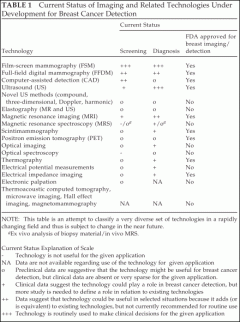
TABLE 1 - Current Status of Imaging and Related Technologies Under Development for Breast Cancer Detection
NOTE: This table is an attempt to classify a very diverse set of technologies in a rapidly changing field and thus is subject to change in the near future.
Ideal detection performance may ultimately depend on multimodality imaging, as no single imaging technology to date can accurately detect all significant lesions. Ultrasound and MRI in particular have shown potential as adjuncts to mammography for diagnostic and screening purposes, especially for women in whom the accuracy of mammography is not optimal, such as those with dense breasts. MRI and ultrasound imaging may also facilitate new minimally invasive methods for the treatment of early lesions that are under investigation, but clinical trials are needed to assess the value of the procedures.
Written and revised by
David Cohen, M.D.
Our doctors write and review articles for accuracy and keep them up to date.
health.am provides general information, not medical advice. Always consult a qualified health professional about your own health.
Explore health topics
More in this topic
Cancer → News
Slight changes in 2 key genes appear to launch breast cancer development
Researchers at Georgetown Lombard Comprehensive Cancer Center have been able to show, in mice, how just a little adjustment in the expression of two common genes can promote the kind of cellular changes that led to…
14 May 2010
 News
Breast density change linked to cancer development in WHI hormone replacement study
An increase in breast density appears to be the culprit behind an increase of breast cancer found in women participating in the estrogen and progestin therapy study, a part of the Women's Health Initiative (WHI). That…
21 April 2010
 News
Protein plays a critical role in the development of aggressive breast cancer
Researchers at Fox Chase Cancer Center have identified a potentially significant molecular player in the development of aggressive breast cancer. The team's findings show that a protein called NEDD9 is critical in the…