Developing Technologies for the Early Detection of Breast Cancer
Key points
- Breast cancer is the most common non-skin-related malignancy and the second leading cause of cancer death among women in the United States1 .
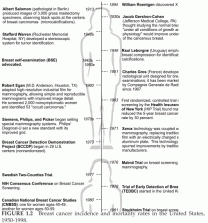
- Fifty years ago, there was no established method for the detection of breast cancer at an early stage or for screening of the general population, but advances in technology, policy recommendations by various organizations, and legal mandates have thoroughly changed that situation (Figure 1-1).
- X-ray film mammography and physical examination of the breast are now the mainstays for early detection of breast cancer.
- (1990), Kevles (1997); Jatoi (1999), Moss (1999), and Lerner (2001).
Breast cancer is the most common non-skin-related malignancy and the second leading cause of cancer death among women in the United States1 . Each year, more than 180,000 new cases of invasive breast cancer are diagnosed and more than 40,000 women die from the disease. Until research uncovers a way to prevent breast cancer or to cure all women regardless of when their tumor is found, early detection will be looked upon as the best hope for reducing the heavy toll of this disease. The early detection of cervical cancer by screening with the Papanicolaou smear (the Pap smear) dramatically reduced mortality from that cancer, and the rationale for the early detection of breast cancer is similar.
Fifty years ago, there was no established method for the detection of breast cancer at an early stage or for screening of the general population, but advances in technology, policy recommendations by various organizations, and legal mandates have thoroughly changed that situation (Figure 1-1). Although the use of X-ray imaging for the detection of breast cancer was first suggested in the early 1900s, mammography did not begin to emerge as an accepted technology until the 1960s, after a number of technical innovations that produced higher-quality images that were more reproducible and easier to interpret were introduced. Subsequently, some physicians began ordering mammograms to help with the diagnosis of complicated cases, and the technology was also tested as a screening tool (reviewed by Lerner, 2001).
X-ray film mammography and physical examination of the breast are now the mainstays for early detection of breast cancer. Screening for early cancer detection has been credited for part of the recent reduction in breast cancer mortality, which had been stagnant for 40 years (Blanks et al., 2000; Hakama et al., 1997; Mettlin, 1999; Peto et al., 2000). (Adjuvant therapy is also credited with reducing breast cancer mortality). New or improved technologies are also rapidly emerging and providing new hope of early detection.
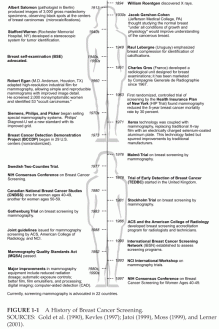
FIGURE 1-1 A History of Breast Cancer Screening.
SOURCES: Gold et al. (1990), Kevles (1997); Jatoi (1999), Moss (1999), and Lerner (2001).
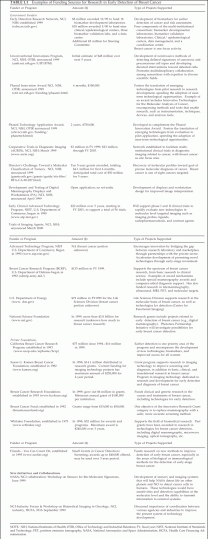
Over the past decade, the investment in breast cancer research, including early detection, has increased substantially. Research has intensified with federal funding, and private firms have turned more attention to breast cancer detection. Programs within the U.S. Department of Health and Human Services and the U.S. Department of Defense support large numbers of investigators working on breast cancer, and recently, the National Aeronautics and Space Administration and several intelligence services have agreed to apply their imaging expertise to mammography (Table 1-1). Biotechnology and device companies have proliferated, with many developing technologies that might improve the ability to detect breast cancer early, and established firms have also turned their attention to breast cancer, in part as the result of findings derived from the rising federal research investment.
Written and revised by
David Cohen, M.D.
Our doctors write and review articles for accuracy and keep them up to date.
health.am provides general information, not medical advice. Always consult a qualified health professional about your own health.
Explore health topics
More in this topic
Cancer → News
Most elderly women with early stage breast cancer receive a treatment that may not be as effective
A new analysis has found that while clinical trial data support omitting radiation treatments in elderly women with early stage breast cancer, nearly two-thirds of these women continue to receive it. The findings are…
9 December 2014
 News
Mental health inequalities in detection of breast cancer
Women with a mental illness (including depression, anxiety and serious mental illnesses) are less likely to be screened for breast cancer, according to new research published in the BJPsych (online first). The research…
2 December 2014
 News
Trastuzumab continues to show life for HER2-positve early stage breast cancer
After following breast cancer patients for an average of eight-plus years, researchers say that adding trastuzumab (Herceptin) to chemotherapy significantly improved the overall and disease-free survival of women with…