
Prevention Strategies for Women with BRCA1 or BRCA2 Mutations
Key points
- Given the uncertain utility of screening programs (secondary prevention) in this high-risk population, some women consider undergoing surgical procedures in an attempt to manage their risk.
- Unfortunately, failure can occur as the result of the development of breast cancer in residual breast tissue.
- Laparoscopic risk-reducing salpingo-oophorectomy is performed more commonly, particularly in women who have completed child-bearing and are nearing menopause.
- Nevertheless, because of uncertainties regarding the effectiveness of ovarian cancer screening and the perceived high case-fatality rate of ovarian cancer, a significant fraction of women at defined hereditary risk choose to undergo the procedure.
Given the uncertain utility of screening programs (secondary prevention) in this high-risk population, some women consider undergoing surgical procedures in an attempt to manage their risk. Bilateral risk-reducing mastectomy appears to be approximately 90% effective in reducing breast cancer incidence and mortality in women with a significant familial risk.
Unfortunately, failure can occur as the result of the development of breast cancer in residual breast tissue. This is a particular issue after subcutaneous mastectomy, but even women undergoing total (simple) mastectomy may develop cancer in ectopic rests of breast tissue (e.g., in the axilla). The effectiveness of mastectomy in women with germline BRCA mutations has not been defined. Despite its presumed effectiveness, the uptake of risk-reducing mastectomy by such women in the United States appears to be quite low.
Laparoscopic risk-reducing salpingo-oophorectomy is performed more commonly, particularly in women who have completed child-bearing and are nearing menopause. There are few data regarding the effectiveness of this procedure in reducing ovarian cancer risk. Oophorectomy cannot be considered completely protective, as cases of primary peritoneal carcinoma have been described after surgery.
Nevertheless, because of uncertainties regarding the effectiveness of ovarian cancer screening and the perceived high case-fatality rate of ovarian cancer, a significant fraction of women at defined hereditary risk choose to undergo the procedure. On a policy level, two separate decision analyses have demonstrated that risk-reducing surgery (mastectomy and/or oophorectomy) is a cost-effective way to manage cancer risk in this population. While these analyses are encouraging, it is difficult to translate these population benefits in a meaningful way to an individual patient.
There has been considerable interest in the use of chemoprevention as a means to reduce cancer risk. In particular, the encouraging results of the NSABP-P1 trial have provided a springboard for investigating the use of antiestrogens in BRCA families. At this time, it is unknown whether this strategy will be as effective as it is in the wider population.
Of particular concern is the fact that many BRCA-associated breast cancers are hormone-receptor negative, and neither tamoxifen nor raloxifene substantially affect the incidence of such tumors. Further analysis of the P1 study is ongoing to determine the impact of antiestrogen therapy on breast cancer risk in BRCA heterozygotes. Until these results are available, the use of tamoxifen and other antiestrogens should be considered investigational in this group.
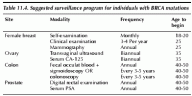
Table 11.4. Suggested surveillance program for individuals with BRCA mutations
Oral contraceptives have been known for some time to reduce ovarian cancer risk in the general population. A recent study has indicated a similar beneficial effect in BRCA heterozygotes. Specifically, heterozygotes who took oral contraceptives for any period of time had a relative risk for ovarian cancer of 0.5 (95% CI 0.3-0.8) when compared to controls. Benefit seemed to accrue particularly to women who took oral contraceptives for over 3 years.
Written and revised by
Gerald Hurowitz, M.D.
Our doctors write and review articles for accuracy and keep them up to date.
health.am provides general information, not medical advice. Always consult a qualified health professional about your own health.
Explore health topics
More in this topic
Cancer → News
No association between lung cancer risk in women and reproductive history or hormone use
The Women's Health Initiative Studies, a large prospective study of lung cancer, found no strong associations between lung cancer risk and a wide range of reproductive history variables and only revealed weak support…
9 April 2015
 News
Cancer prevention efforts in the US a mixed bag
While there has been substantial progress in some cancer control efforts in the past several decades, like reductions in smoking and increased utilization of cancer screening, progress in some areas is lagging,…
2 April 2015
 News
Most women with early-stage breast cancer avoid extensive lymph node removal
A new study of women with early-stage breast cancer finds that surgeons no longer universally remove most of the lymph nodes in the underarm area when a biopsy of the nearby lymph nodes shows cancer - a major change in…




