
Functions of BRCA1 and BRCA2 and the Mechanism of Hereditary Susceptibility
Key points
- The functions of BRCA1 and BRCA2 are incompletely defined.
- The susceptibility conferred by a germline mutation appears to follow the classic tumor-suppressor model, in that the normal copy of the gene must be mutated or lost before the predisposition can be expressed.
- Cells lacking BRCA1 or BRCA2 function appear to be defective in their ability to resolve double-stranded DNA breaks.
- Such cells appear to be prone to accumulate additional genetic damage, and are sensitive to the effects of DNA-damaging agents such as ionizing radiation and certain chemotherapeutic agents.
The functions of BRCA1 and BRCA2 are incompletely defined. The genes share little sequence homology, although there are some similarities in exon structure.
The susceptibility conferred by a germline mutation appears to follow the classic tumor-suppressor model, in that the normal copy of the gene must be mutated or lost before the predisposition can be expressed.
Current evidence suggests that the products of these genes function in a DNA-damage repair pathway (reviewed in ref. 8). Cells lacking BRCA1 or BRCA2 function appear to be defective in their ability to resolve double-stranded DNA breaks.
Such cells appear to be prone to accumulate additional genetic damage, and are sensitive to the effects of DNA-damaging agents such as ionizing radiation and certain chemotherapeutic agents. The two gene products appear to participate in a common pathway and have been reported to physically coexist in a biochemical complex.
The exact mechanism by which loss of BRCA1 or BRCA2 function produces the observed predisposition to cancer is not known. One hypothesis suggests that loss of gene function is an early event, with cells lacking BRCA1 or BRCA2 being prone to acquire the additional genetic changes that lead to the malignant phenotype. The restricted tissue expression of this predisposition is currently unexplained.
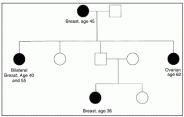
Fig. 11.1. Hereditary breast-ovarian cancer pedigree demonstrating autosomal dominant inheritance.
Mark E. Robson
Breast conservation therapy for invasive breast cancer in Ashkenazi women with BRCA gene founder mutations. J Natl Cancer Inst 2003
Written and revised by
Gerald Hurowitz, M.D.
Our doctors write and review articles for accuracy and keep them up to date.
health.am provides general information, not medical advice. Always consult a qualified health professional about your own health.
Explore health topics
More in this topic
Cancer → News
Researchers detail possible resistance mechanisms of colorectal cancer to bevacizumab (Avastin)
A University of Colorado Cancer Center study published in the journal PLoS One shows that when colorectal cancer is targeted by the drug bevacizumab (Avastin), tumors may switch dependence from VEGF-A, which is targeted…
29 October 2013
 News
Scientists pinpoint a new molecular mechanism tied to pancreatic cancer
New research led by scientists at The University of Texas Health Science Center at Houston (UTHealth) and Baylor College of Medicine could aid efforts to diagnose and treat one of the most lethal and hard-to-treat types…
23 August 2013
 News
Mechanism offers promising new approach for harnessing the immune system to fight cancer
St. Jude Children's Research Hospital scientists have discovered a way to target the immune system to shrink or eliminate tumors in mice without causing autoimmune problems. Researchers also found evidence that the same…







