
Cancer Risks in Individuals with a BRCA1 or BRCA2 Mutation
Key points
- The identification of unaffected women with BRCA1 or BRCA2 mutations provides an opportunity to reduce cancer mortality by enrolling such ndividuals in intensive surveillance and prevention programs.
- Such programs would appear to be justified by the significantly increased cancer risks aced by these women.
- The higher estimates are generated by the study of families with dramatic pedigrees, such as those included in the Breast Cancer Linkage Consortium effort.
- Lower estimates arise from the study of less highly selected families.
The identification of unaffected women with BRCA1 or BRCA2 mutations provides an opportunity to reduce cancer mortality by enrolling such ndividuals in intensive surveillance and prevention programs.
Such programs would appear to be justified by the significantly increased cancer risks aced by these women. Unfortunately, the exact degree to which risk is elevated remains a topic of active investigation. Current estimates of cancer risks among BRCA1 or BRCA2 heterozygotes are shown in Table 11.3. The lifetime breast cancer risk for a woman with a mutation in either gene is estimated to be 50-85%.
The higher estimates are generated by the study of families with dramatic pedigrees, such as those included in the Breast Cancer Linkage Consortium effort.
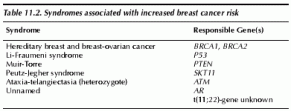
Table 11.2. Syndromes associated with increased breast cancer risk
Lower estimates arise from the study of less highly selected families. Risk estimates range widely due to differences in methods of ascertainment and penetrance calculation. In addition, unidentified genetic or environmental factors may exist that may be distributed differently in the reported study populations. Factors modulating cancer risks in this population are not well described but may be different from those that are operative in populations that do not have an inherited predisposition.
It is crucial to recognize that the Gail model or "Claus tables" may substantially underestimate breast cancer risk in hereditary breast-ovarian cancer families, and such models should not be used for this purpose.
Although there are few data, the contralateral breast cancer risk by age 70 in women with BRCA1 mutations who have undergone mastectomy for one breast cancer is estimated to be as high as 65% and is likely to be similar for BRCA2 heterozygotes. Male BRCA2 heterozygotes are estimated to have an up to 6% lifetime risk of breast cancer.
The estimated risk of ovarian cancer ranges between 15% and 65% for BRCA1 heterozygotes and between 10% and 20% for those with mutations in BRCA2. Women with mutations in either gene also appear to be at increased risk for fallopian tube cancer and primary peritoneal carcinoma, but the level of this risk is undefined. As with breast cancer risk, estimates of ovarian cancer risk may vary as a result of ascertainment biases, or as a consequence of unidentified environmental or genetic factors. Other cancers that may occur with increased frequency in hereditary breast cancer families include colon (BRCA1), prostate (BRCA1 and BRCA2), pancreas (BRCA2) and larynx (BRCA2).
Mark E. Robson
Breast conservation therapy for invasive breast cancer in Ashkenazi women with BRCA gene founder mutations. J Natl Cancer Inst 2003
Written and revised by
Andrey Nailor, M.D.
Our doctors write and review articles for accuracy and keep them up to date.
health.am provides general information, not medical advice. Always consult a qualified health professional about your own health.
Explore health topics
More in this topic
Cancer → News
Montreal researchers shed new light on cancer risks associated with night work
Night work can increase cancer risk in men, according to a new study published in the American Journal of Epidemiology by a research team from Centre INRS–Institut Armand-Frappier and Centre de recherche du Centre…
16 October 2012
 News
Low-dose CT screening may benefit individuals at increased risk for lung cancer
Peter B. Bach, M.D., of the Memorial Sloan-Kettering Cancer Center, New York, and colleagues conducted a systematic review to examine the evidence regarding the benefits and harms of low-dose computerized tomography…
21 May 2012
 News
Brachytherapy: Targeted Breast Cancer Treatment Comes With Risks
An increasing number of women are treating their breast cancer with brachytherapy, a type of radiation therapy that delivers a smaller, more targeted dose of radiation. But a new study suggests that the treatment might…






