Head and Neck Cancer Treatment
Key points
- Patients with head and neck cancer can be categorized into three clinical groups: those with localized disease, those with locally or regionally advanced disease, and those with recurrent and/or metastatic disease.
- In this strategy, patients receive chemotherapy [usually cisplatin and fluorouracil (5FU)] before surgery and radiation therapy.
- β-Carotene and cis-retinoic acid can lead to the regression of leukoplakia.
- Complications from treatment of head and neck cancer are usually related to the extent of surgery.
Patients with head and neck cancer can be categorized into three clinical groups: those with localized disease, those with locally or regionally advanced disease, and those with recurrent and/or metastatic disease. Comorbidities associated with tobacco and alcohol abuse can affect treatment outcome.
Localized Disease - Nearly one-third of patients have localized disease; that is, T1 or T2 (stage I or stage II) lesions without detectable lymph node involvement or distant metastases. These lesions are treated with curative intent by surgery or radiation therapy. The choice of modality differs according to institutional expertise. Radiation therapy is often preferred for laryngeal cancer to preserve voice function, and surgery is preferred for small lesions in the oral cavity to avoid the long-term complications of radiation, such as xerostomia and dental decay. Overall 5-year survival is 60 to 90%.
Locally or Regionally Advanced Disease - Locally or regionally advanced disease - disease with a large primary tumor and/or lymph node metastases - can also be treated with curative intent, but not with surgery or radiation therapy alone. Combined modality therapy including surgery, radiation therapy, and chemotherapy is most successful. Concomitant chemotherapy and radiation therapy appears to be most effective.
Head and Neck Cancer
Introduction
Incidence and Epidemiology
Etiology and Genetics
Hostopathology & Carcinogenesis
Differential Diagnosis
Treatment
Chemoprevention
Treatment Complications
Further Reading
INDUCTION CHEMOTHERAPY
In this strategy, patients receive chemotherapy [usually cisplatin and fluorouracil (5FU)] before surgery and radiation therapy. Most patients who receive three cycles show tumor reduction, and the response is clinically "complete" in up to half. This "sequential" multimodality therapy does not cure more patients than surgery plus radiation therapy alone. However, induction chemotherapy allows for organ preservation in patients with laryngeal and hypopharyngeal cancer.
CONCOMITANT CHEMORADIOTHERAPY
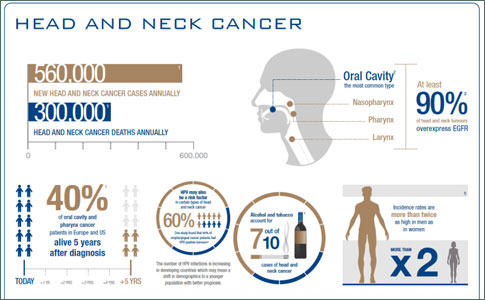
With the concomitant strategy, chemotherapy and radiation therapy are given simultaneously rather than sequentially. Because most patients with head and neck cancer develop recurrent disease in the head and neck area, this approach is aimed at killing radiation-resistant cancer cells with chemotherapy. In addition, chemotherapy can enhance cell killing by radiation therapy. Toxicity (mucositis) is increased with concomitant chemoradiotherapy; however, meta-analysis of randomized trials documents an improvement in 5-year survival of 8% with concomitant 5FU and radiation therapy. Results seem even better with 5FU and cisplatin plus radiation therapy. Five-year survival is 34 to 50%. In addition, concomitant chemoradiotherapy produces better laryngectomy-free survival (organ preservation) than induction chemotherapy in patients with advanced larynx cancer. The use of radiation therapy together with cisplatin has produced markedly improved survival in patients with advanced nasopharyngeal cancer. The success of concomitant chemoradiotherapy in patients with unresectable disease has led to the testing of a similar approach in patients with resected disease as a postoperative therapy, but results to date have not convincingly shown improvement over postoperative radiation therapy alone.
Written and revised by
Andrey Nailor, M.D.
Our doctors write and review articles for accuracy and keep them up to date.
health.am provides general information, not medical advice. Always consult a qualified health professional about your own health.
Explore health topics
More in this topic
Cancer → News
Study finds more targeted form of radiation improves survival in patients with head and neck cancers
Patients with cancers of the head and neck who received intensity-modulated radiation therapy (IMRT) - a technology designed to more precisely target cancer cells and spare nearby tissue - experienced improved outcomes,…
14 January 2014
 News
Genetic diversity within tumors predicts outcome in head and neck cancer
A new measure of the heterogeneity – the variety of genetic mutations - of cells within a tumor appears to predict treatment outcomes of patients with the most common type of head and neck cancer. In the May 20 issue of…
20 May 2013
 News
Protein Aurora-A is found to be associated with survival in head and neck cancer
Researchers at Fox Chase Cancer Center in Philadelphia have found that a protein associated with other cancers appears to also be important in head and neck cancer, and may consequently serve as a good target for new…