Accelerated and Hyperfractionated Radiotherapy - treatment of head and neck cancer
Key points
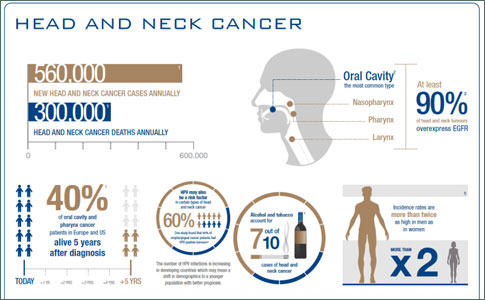
- Accelerated and Hyperfractionated Radiotherapy - treatment of head and neck cancer An area of current interest in the treatment of head and neck cancer is to use "nonstandard" radiation treatment regimens to improve the therapeutic ratio between tumor control and normal tissue damage.
- Hyperfractionation refers to using smaller fraction sizes, multiple daily treatments, a higher total dose of radiation, and a total treatment time that is about the same duration as for conventional radiotherapy.
- Accelerated fractionation refers to using a fraction about the same size (or perhaps slightly smaller) as in conventional fractionation, multiple daily treatments, a shorter overall treatment time, and a total dose about the same (or perhaps slightly less) than given in the conventional radiation schema.
- The basic idea with this approach is to overcome the effects of tumor repopulation by shortening the overall time.
Accelerated and Hyperfractionated Radiotherapy - treatment of head and neck cancer
An area of current interest in the treatment of head and neck cancer is to use "nonstandard" radiation treatment regimens to improve the therapeutic ratio between tumor control and normal tissue damage. Standard once-a-day treatment approaches developed empirically, and while they are convenient from the viewpoint of operating a radiation oncology department, there is no reason to think that they cannot be improved upon. There are currently two basic approaches that are being investigated in an attempt to find a more optimal radiation treatment fractionation schema.
Hyperfractionation refers to using smaller fraction sizes, multiple daily treatments, a higher total dose of radiation, and a total treatment time that is about the same duration as for conventional radiotherapy. The basic idea with this approach is to take advantage of the difference in the shapes of the cell survival curves between tumors and late-responding tissues in order to deliver a higher dose of radiation without increasing the late effects of treatment. A typical example for head and neck cancer would be to give 120 cGy per fraction (Fx) twice daily (bid) to a total dose of 8,160 cGy. The interval between fractions must be approximately 4.5 to 6 h to allow for repair of damage to normal tissues.
Accelerated fractionation refers to using a fraction about the same size (or perhaps slightly smaller) as in conventional fractionation, multiple daily treatments, a shorter overall treatment time, and a total dose about the same (or perhaps slightly less) than given in the conventional radiation schema.
The basic idea with this approach is to overcome the effects of tumor repopulation by shortening the overall time. Theoretically, this should improve tumor control for the same radiation dose without increasing the overall late effects. Following Ang, the various accelerated fractionation schemas can be classified into three categories: A, a short, intensive course; B, a split course; and C, a concomitant boost. The continuous hyperfractionated accelerated radiotherapy (CHART) regimen, which consists of giving 150 cGy/Fx three times a day on 12 consecutive days to a total dose of 5,400 cGy, is a prototype regimen in category A. The approach of Wang and colleagues (160 cGy/Fx bid to a total dose of 6,720 cGy with a 2-week break after 3,840 cGy) is a prototype regimen in category B. The concomitant-boost approach of Ang and colleagues (180 cGy/Fx qd to 5,400 cGy, with an additional daily treatment of 150 cGy/Fx to the final target volume being delivered during the final 12 days of therapy) is a prototype regimen in category C.
Model calculations show that which of these approaches would be expected to produce the best results is critically dependent on the radiobiologic parameters of the tumor (eg, a/b, and the tumor proliferative properties [eg, TD and F]). In clinical practice, even tumors arising in a particular site and having the same basic histology can exhibit a wide variation in the values for these parameters. In the absence of predictive assays that would allow the clinician to individualize the treatment for a given patient, large-scale clinical trials are necessary to compare one approach to another for the treatment of specific classes of tumors.
Written and revised by
David Cohen, M.D.
Our doctors write and review articles for accuracy and keep them up to date.
health.am provides general information, not medical advice. Always consult a qualified health professional about your own health.
Explore health topics
More in this topic
Cancer → News
Radiotherapy Advance Builds Hope for Noninvasive Brain Cancer Treatment
With an equal rate of incidence and mortality-the number of those who get it, and the number of those who die from it-Glioblastoma Multiforme (GBM) is a brain cancer death sentence. Of the approximately 12,000 people…
3 January 2006
 News
Anti-tumor immunity identified with new ovarian cancer treatment strategy
Few effective treatments have been approved to treat ovarian cancer , the deadliest of all cancers affecting the female reproductive system. Now, new research from The Wistar Institute demonstrates how a drug already in…
28 September 2016
 News
People with hepatitis C are two to five times more likely to develop certain head and neck cancers
Long associated with liver cancer and non-Hodgkin's lymphoma , a study from The University of Texas MD Anderson Cancer Center reveals for the first time that the hepatitis C virus (HCV) is associated with certain head…