Complications of Axillary Dissection
Key points
- The axillary surgery causes the bulk of postoperative discomfort for breast cancer patients, and minor complications are frequent.
- Borgen and Bruce Mann Breast conservation therapy for invasive carcinoma of the breast.
- Lymphedema and recurrent cellulitis are the most feared and potentially disabling of the complications.
- The extent of axillary surgery and the use of axillary radiation therapy are the only factors that have been consistently associated with the formation of lymphedema.
The axillary surgery causes the bulk of postoperative discomfort for breast cancer patients, and minor complications are frequent. Seromas are frequently seen, especially if the drain is removed early. These can be managed by aspiration in the outpatient clinic. In the long term, numbness in the medial aspect of the arm is universal if the intercostobrachial nerve has been divided.
Lymphedema and recurrent cellulitis are the most feared and potentially disabling of the complications. The reported incidence of lymphedema varies from 7-60% according to the methods used to assess the arm and the interval between surgery and follow-up. Many recent studies have reported a 15-20% incidence after treatment with axillary dissection or axillary irradiation. The incidence is much higher if both surgery and radiation therapy are used.
The extent of axillary surgery and the use of axillary radiation therapy are the only factors that have been consistently associated with the formation of lymphedema. Older age, obesity and infection are other likely risk factors.
Lymphedema can appear years after the surgery. It is routine to advise patients to avoid arm swelling and infection by taking special care not to suffer cuts and scrapes on the operated side, to avoid injections, blood-pressure monitoring, and blood draws, to avoid constricting clothing and jewelry, etc.
Warmuth reported a survey of 330 patients who were disease-free 2-5 years after surgery for early-stage breast cancer. Thirty-five percent reported numbness, 30% reported pain, 15% reported arm swelling, and 8% reported limitation of arm movement. Most of the symptoms were mild and did not interfere significantly with daily activity.
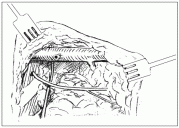
Fig. 7.11. Axillary dissection in progress. The anterior tributary of the axillary vein has been divided, the intercostobrachial nerve has been preserved and the long thoracic nerve identified.
{embed="ref/21"}
References
- Veronesi U, Saccozzi R, Del Vecchio M et al. Comparing radical mastectomy with quadrantectomy, axillary dissection, and radiation therapy in patients with small cancers of the breast. N Engl J Med 1981; 305:6-11.
This is the landmark report of the first randomized prospective trial of breast-conservation therapy. - Fisher B, Bauer M, Margolese R et al. Five-year results of a randomized clinical trial comparing total mastectomy and segmental mastectomy with or without radiation in the treatment of breast cancer. N Engl J Med 1985; 312:665-73.
This is the first report of the major North American trial of breast-conservation therapy from the NSABP. - Borgen PI, Heerdt AS, Moore MP et al. Breast conservation therapy for invasive carcinoma of the breast. Current Problems in Surgery 1995; 33:189-256.
Written and revised by
David Cohen, M.D.
Our doctors write and review articles for accuracy and keep them up to date.
health.am provides general information, not medical advice. Always consult a qualified health professional about your own health.
Explore health topics
More in this topic
Cancer → News
Anti-tumor immunity identified with new ovarian cancer treatment strategy
Few effective treatments have been approved to treat ovarian cancer , the deadliest of all cancers affecting the female reproductive system. Now, new research from The Wistar Institute demonstrates how a drug already in…
28 September 2016
 News
Study examines survival outcomes after different lung cancer staging methods
In a study appearing in the September 13 issue of JAMA, Jouke T. Annema, M.D., Ph.D., of the Academic Medical Center, Amsterdam, and colleagues examined five-year survival after endosonography vs mediastinoscopy for…
28 September 2016
 News
New strategy identified for treating acute myeloid leukemia
A multi-institutional academic and industry research team led by investigators from Massachusetts General Hospital (MGH) and the Harvard Stem Cell Institute has identified a promising new approach to the treatment of…