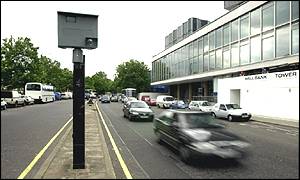
Speed camera plan 'may cause deaths'
Key points
- Government plans to introduce high visibility speed cameras may actually increase deaths rather than improve road safety, experts have warned.
- Mr Pilkington, who works in Bristol, suggested high visibility cameras would not be as effective.
- The journal also highlights the risks of driving when tired.
- Ministers announced plans last year to paint speed cameras yellow to ensure they could be seen by motorists and to ban warning signs on roads where there were no cameras.
Government plans to introduce high visibility speed cameras may actually increase deaths rather than improve road safety, experts have warned.
Ministers announced plans last year to paint speed cameras yellow to ensure they could be seen by motorists and to ban warning signs on roads where there were no cameras.
The policy is aimed at cutting road accidents amid fears that many drivers break suddenly when they see or are warned of speed cameras.
However, public health specialist Paul Pilkington has warned there is no evidence to support the government's claims.
Writing in the latest issue of the British Medical Journal, he said hidden cameras had been shown to reduce deaths and injury on roads.
'No evidence'
Mr Pilkington, who works in Bristol, suggested high visibility cameras would not be as effective.
He said drivers would simply drive slowly in areas with cameras and accelerate in those areas without the deterrent.
"These measures seem designed to placate the angry minority of motorists who believe that drivers should be warned about impending cameras, giving them the chance to slow down.
"But this view is not based on evidence of health benefits. Hidden cameras are associated with net falls in speeds, crashes and casualties when compared with visible ones."
He added: "The introduction of high visibility speed cameras is a mistake. We need evidence that they are more effective than hidden cameras."
But a spokesman for the Department of Transport rejected the claim. He said cameras were placed in areas where motorists were most at risk of having an accident.
He said: "Cameras are situated in areas where there is a history of accidents. When people see cameras ahead they do slow down. Slowing down at dangerous stretches of a road is very good."
He added: "Making the cameras more visible gives drivers enough distance to slow down and takes away the need for sudden breaking. Gradual breaking is much better than sudden breaking."
In other research, published in the BMJ, doctors warned that driver air bags offered relatively little benefit to motorists compared to seat belts.
They found that seat belts provide much more effective protection, reducing the risk of death by 65%. This compares with air bags which, they said, were associated with an 8% reduction in risk.
A study by Canadian doctors also showed that seat belts provided effective protection to children even though they are usually designed to be used by adults.
Sleep risks
"When people see cameras ahead they do slow down"
Written and revised by
David Cohen, M.D.
Our doctors write and review articles for accuracy and keep them up to date.
health.am provides general information, not medical advice. Always consult a qualified health professional about your own health.
Explore health topics
More in this topic
Sleep → News
More than one-third of perimenopausal women develop insomnia
Millions of women may likely be sleep-deprived. It's already a known fact that women are more predisposed to insomnia. Now a new study presented at the 2015 Annual Meeting of The North American Menopause Society (NAMS)…
14 October 2015
NewsNew symptom may help ID sleep apnea in older women
The results of a new study suggest that nocturnal enuresis, or bedwetting, may be an additional symptom that doctors can look for when assessing post-menopausal women for obstructive sleep apnea. That condition left…
2 September 2015
 News
The timing of sleep just as important as quantity
Washington State University researchers have found that the timing of an animal's sleep can be just as important as how much sleeps it gets. Ilia Karatsoreos, an assistant professor in WSU's Department of Integrative…
1 September 2015