
How a pimple is born
Key points
- Certain steps and factors are necessary in the development of a pimple.
- The earliest lesions of acne are closed comedones (clogged pores not open to the surface, whiteheads) and open comedones (clogged pores open to the surface, blackheads).
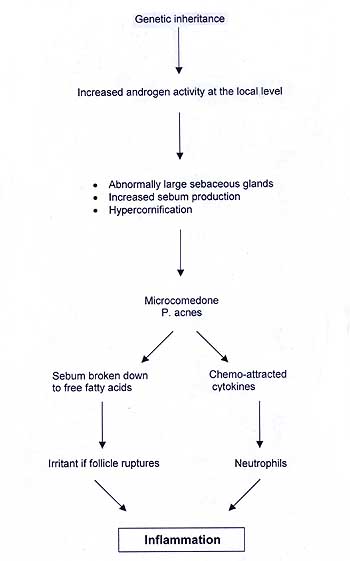
- It all starts with a genetic predisposition and the ability to convert testosterone to dihydrotestosterone in the sebaceous gland due to the presence of the enzyme 5 alpha-reductase.
- Sebaceous glands enlarge, produce more oil, the skin start shedding more skin cells and clog the pores, and when bacteria enter the scene, things really get going.
Certain steps and factors are necessary in the development of a pimple.
It all starts with a genetic predisposition and the ability to convert testosterone to dihydrotestosterone in the sebaceous gland due to the presence of the enzyme 5 alpha-reductase.
Sebaceous glands enlarge, produce more oil, the skin start shedding more skin cells and clog the pores, and when bacteria enter the scene, things really get going. Now its only a matter of breakage of the follicles and inflammation and you have full-blown acne.
The four factors involved in the development of a pimple, are:
- increased production of oil stimulated by androgenic (male) hormones.
- obstruction of the opening of the follicle caused by increased production of scales.
- infection by a bacterium, namely Propionibacterium acnes.
- rupture (breakage) of the follicle, leading to inflammation.
Genetic factors may play a role. Acne often occurs in families.
Stress may aggravate acne but is not causal. Acne may cause stress.
The earliest lesions of acne are closed comedones (clogged pores not open to the surface, whiteheads) and open comedones (clogged pores open to the surface, blackheads). Breakage of these structures leads to the development of all other lesions.
Written and revised by
Gerald Hurowitz, M.D.
Our doctors write and review articles for accuracy and keep them up to date.
health.am provides general information, not medical advice. Always consult a qualified health professional about your own health.
Explore health topics
More in this topic
Skin, Hair & Beauty → News
Sunscreens Remain Safe, Effective Form of Sun Protection
The American Academy of Dermatology (Academy) today reiterated the safety and effectiveness of sunscreens to protect against the damaging effects from exposure to ultraviolet (UV) radiation. As one component of a daily…
15 May 2012
 News
Gene therapy for hearing loss: potential and limitations
Regenerating sensory hair cells, which produce electrical signals in response to vibrations within the inner ear, could form the basis for treating age- or trauma-related hearing loss. One way to do this could be with…
12 May 2012
News32% of young white women do indoor tanning
Despite years of warning about the hazards, about a third of young white women use indoor tanning equipment, increasing their risk of deadly skin cancer, says a study out today. It's the first major federal assessment…
10 May 2012