Syndromic obesity - The Genetics of Human Obesity
Key points
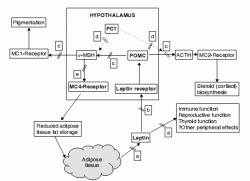
- Figure 2.1 Protein products of genes known to be associated with human monogenic forms of obesity are shown in bold (see also Table 2.1).
- BBS prevalence varies widely, ranging from as little as 1:160 000 in ethnic Europeans to as much as 1:13 000 in populations such as Kuwait and Newfoundland where a founder effect has been postulated.
- The ob gene mutation causing an absence of leptin is represented by (a) and leptin receptor mutations by (b).
- The precise cellular function of snoRNAs has yet to be determined but they are thought to play a part in the cellular localization and processing of RNA transcripts.
Prader–Willi syndrome Long known to result from the deletion of a paternally inherited 4–4.5-Mb segment of chromosome 15, Prader–Willi syndrome
(PWS) exhibits the interesting phenomenon of 'genetic imprinting'; when the deletion is inherited from the mother, Angelman syndrome (which does not have obesity as a cardinal feature) results but when the deletion is inherited from the father, loss of expression of one or more of the many C/D box, small nucleolar RNAs (snoRNAs) encoded within the paternally expressed small nuclear riboprotein N (SNRPN) locus permits the PWS phenotype to be expressed.
Figure 2.1 Protein products of genes known to be associated with human monogenic forms of obesity are shown in bold (see also Table 2.1). POMC, pro-opiomelanocortin; α-MSH, α-melanocyte stimulating hormone; PC-1, pro-hormone convertase-1; MC-1, 2 and 4, melanocortin-1, 2 and 4 receptors.
The ob gene mutation causing an absence of leptin is represented by (a) and leptin receptor mutations by (b). POMC mutations (c) disrupt cortisol biosynthesis and α-MSH-induced pigmentation as well as appetite regulation whereas PC-1 mutations (d) do not appear to have a major effect on pigmentation but instead lead to hypogonadism and glucoregulatory abnormalities. MC-4 mutations (e) are notable for causing little disturbance to regulatory pathways other than appetite and thus best represent common forms of non-syndromic obesity.
Generalized disruptions to the normal paternal expression of genes in this region (such as maternal uniparental disomy 15, imprinting centre mutations and specific balanced translocations with breakpoints within the paternally expressed SNRPN locus have also been reported to lead to PWS phenotype expression (Nicholls and Knepper, 2001). The precise cellular function of snoRNAs has yet to be determined but they are thought to play a part in the cellular localization and processing of RNA transcripts. To date, no link between common forms of human obesity and these abnormalities has been reported.
BBS
This syndrome, until recently considered to be autosomal recessive in nature and frequently confused with the Lawrence–Moon syndrome, is diagnosed on the basis of the presence of a constellation of major and minor features of which obesity (in 72–96 per cent of cases, preferentially distributed in the trunk and proximal limbs), retinal dystrophy, polydactyly, learning disabilities, male hypogonadism and renal abnormalities are most characteristic (Katsanis et al., 2001).
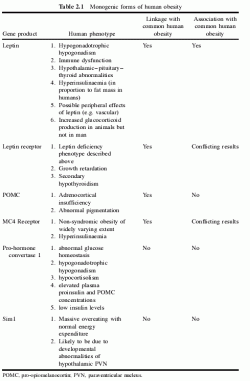
Table 2.1 Monogenic forms of human obesity
Written and revised by
Gerald Hurowitz, M.D.
Our doctors write and review articles for accuracy and keep them up to date.
health.am provides general information, not medical advice. Always consult a qualified health professional about your own health.
Explore health topics
More in this topic
Weight & Nutrition → News
Despite efforts, childhood obesity remains on the rise
The alarming increase in U.S. childhood obesity rates that began nearly 30 years ago continues unabated, with the biggest increases in severe obesity , according to a study led by a Duke Clinical Research Institute…
27 April 2016
 News
Can virtual reality help fight obesity?
Virtual reality offers promising new approaches to assessing and treating people with weight-related disorders, and early applications are revealing valuable information about body image. The advantages of virtual…
25 February 2016
 News
Brain study reveals mindfulness could help prevent obesity in children
Mindfulness, described as paying attention on purpose and being in the present moment with acceptance, could be an effective way to help children avoid obesity. New research published in the journal Heliyon suggests…
22 January 2016