Linkage disequilibrium - The Genetics of Human Obesity
Key points
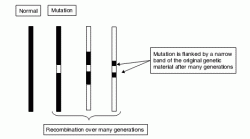
- Linkage disequilibrium (Figure 2.2) is defined as the non-random association between two alleles at two different loci on the same chromosome.
- When a gene mutation first occurs in an individual, it forms part of a unique haplotype, which tends to dissipate over many successive generations as recombination events dislodge alleles at loci on the same chromosome (Figure 2.2).
- Thus LD in such a population may be somewhat analogous to a family linkage study over many generations with an ancestral haplotype replacing a parental one.
- The degree of LD depends on time elapsed since the mutation arose: in 'older' founder populations, the degree of LD often diminishes but due to more recombination events elsewhere, the ability to fine map a mutation may often be greater.
Linkage disequilibrium (Figure 2.2) is defined as the non-random association between two alleles at two different loci on the same chromosome. Although similar to linkage and based on the same fundamental genetic principles, the method is population rather than pedigree based and has the distinct advantage of being able to localize a linkage signal with far greater precision than is possible with traditional linkage alone (Jorde, 2000).
When a gene mutation first occurs in an individual, it forms part of a unique haplotype, which tends to dissipate over many successive generations as recombination events dislodge alleles at loci on the same chromosome (Figure 2.2). As with linkage, loci situated furthest away from the disease gene are most subject to separation from it during meiosis. After many generations (assuming non-lethality and lack of effect on reproductive potential) all that is left of the original chromosome in descendents is the disease gene flanked by a few alleles from the original haplotype which can be used to mark its position.
The ideal circumstances for fine LD mapping are encountered in founder communities (e.g. North-American Hutterites, Amish, Finnish or French-Canadian populations) because it is likely that the disease mutation was introduced by a single individual, producing the potential for a strong association between the disease and a specific haplotype in the current generation. Thus LD in such a population may be somewhat analogous to a family linkage study over many generations with an ancestral haplotype replacing a parental one. The ability to study many more 'offspring' (i.e. the present-day population) for linkage after many recombination events thus confers greater statistical power and much more precise localization than is possible with traditional linkage based methods.
The degree of LD depends on time elapsed since the mutation arose: in 'older' founder populations, the degree of LD often diminishes but due to more recombination events elsewhere, the ability to fine map a mutation may often be greater.
Important constraints of LD based methods include the fact that they depend on the disease of interest existing in suitable founder populations in a way not obscured by marker mutation within the population, new disease mutations, genetic drift, locus heterogeneity, population admixture or the existence of multiple disease susceptibility loci.
Problems related to population structure may also yield false positive results, that is, association without true linkage. Thus, assortive mating causing the eventual emergence of discrete genetic subpopulations (population stratification) and population admixture (where two genetically diverse populations have recently merged) may both lead to the association of unlinked loci.
Thus, additional studies are often required to determine whether a positive association is truly the result of genetic linkage between disease and marker loci.
Written and revised by
David Cohen, M.D.
Our doctors write and review articles for accuracy and keep them up to date.
health.am provides general information, not medical advice. Always consult a qualified health professional about your own health.
Explore health topics
More in this topic
Weight & Nutrition → News
Despite efforts, childhood obesity remains on the rise
The alarming increase in U.S. childhood obesity rates that began nearly 30 years ago continues unabated, with the biggest increases in severe obesity , according to a study led by a Duke Clinical Research Institute…
27 April 2016
 News
Can virtual reality help fight obesity?
Virtual reality offers promising new approaches to assessing and treating people with weight-related disorders, and early applications are revealing valuable information about body image. The advantages of virtual…
25 February 2016
 News
Brain study reveals mindfulness could help prevent obesity in children
Mindfulness, described as paying attention on purpose and being in the present moment with acceptance, could be an effective way to help children avoid obesity. New research published in the journal Heliyon suggests…
22 January 2016