
Study defines different levels of obesity
Key points
- The more obese you are, the more health problems you are bound to have.
- This is the first time the "obese" weight category has been divided into different classes.
- But now we are learning the higher your BMI gets, you will be even more at risk for disease.
- We found one woman who can happily say she does not fall into that category anymore.
The more obese you are, the more health problems you are bound to have. That's what the Utah Department of Health has discovered in its research.
This is the first time the "obese" weight category has been divided into different classes. Obese means you have a body mass index of more than 30.
But now we are learning the higher your BMI gets, you will be even more at risk for disease.
We found one woman who can happily say she does not fall into that category anymore. Addy Moreno does not sit and eat her lunch anymore. Instead she takes her hour break working up a sweat!
Last year at this time, Addy would have been considered obese.
"I'd been trying to lose weight for so long I felt like a failure," she says. "I would try year after year and I never stuck with it."
But she finally stuck with it.
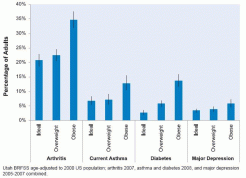
Percentage of Utah adults age 18+ with chronic conditions by weight category.
-Utah Dept. of Health.
"I've lost about 114 pounds," Addy says.
Her risk for chronic diseases has decreased too. Epidemiologists like Michael Friedrichs with the Utah Department of Health have known that obese people are at risk of health problems, but now they know even more.
"We have never looked at the higher classes of obesity to find out if you become more obese, does your risk increase further? That is indeed the case," he says.
So now obesity has been divided into three separate weight classes.
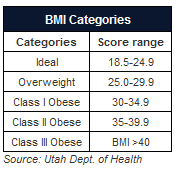
If you have a BMI, which is calculated with your height and weight, of 30 to 35, you fall in the first obese class.
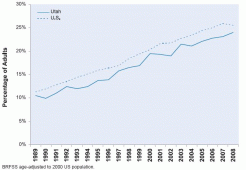
Percentage of adults who were obese, Utah and U.S., 1989-2008.
-Utah Dept. of Health
The second class includes those who fall into the 35 to 40 range.
And 40 and over is the third and potentially most dangerous class for risk of diabetes, asthma, hyper-tension and more.
"If you are overweight or obese, do what you can to lose weight," Friedrichs says. "If you can't lose weight, do what you can to maintain your weight status and not become more obese because your risk increases dramatically."
Something Addy has done. She says losing the weight has helped more then just her health, but her whole life.
"I feel great. I think about all the things I have been missing cause of all the extra weight, and now I feel energetic," she says.
Written and revised by
Gerald Hurowitz, M.D.
Our doctors write and review articles for accuracy and keep them up to date.
health.am provides general information, not medical advice. Always consult a qualified health professional about your own health.
Explore health topics
More in this topic
Weight & Nutrition → News
Current BMI tests underestimate obesity in teens with disabilities
New approaches, based on body mass index (BMI) or other simple measures, are needed to improve assessment of obesity in adolescents with physical disabilities, reports a paper in the American Journal of Physical…
10 June 2015
 News
Earning a college degree before, but not after, getting married protects against obesity
People who earn a college degree before getting married are much less likely to become obese than those who graduate from college after getting married, according to a new study. " People who get married before they…
29 May 2015
NewsTackling obesity needs a number of magic bullets
No one health issue has the most impact on human health, or engenders more debate about how to tackle it, than obesity. It has become the scourge of the health agenda, especially in the west, and it is a growing…




