History of food safety
Key points
- It is likely that the first prehistoric people to enjoy a meal of roasted meat were delighted at how much better it tasted compared to raw foods.
- Ancient people roamed their surroundings in search of edible plants and animals, and it is logical to assume they would have most easily captured animals that were sickly and more likely to harbor disease.
- Gradually, primitive people shifted to a system of farming and domestication of animals.
- Still, early recorded history includes references to dietary practices and records of mass deaths that suggest the existence of foodborne illness.
It is likely that the first prehistoric people to enjoy a meal of roasted meat were delighted at how much better it tasted compared to raw foods. Little did they know that their discovery of fire for cooking their food was also the first step toward reducing foodborne illnesses. Although history does not record the details, it is certain that people have suffered and died from foodborne illness beginning with the very origins of man.
Ancient people roamed their surroundings in search of edible plants and animals, and it is logical to assume they would have most easily captured animals that were sickly and more likely to harbor disease. Because people lacked methods for preserving food, they no doubt ate spoiled and rancid foods that made them sick. Plus, many of them probably died from eating poisonous mushrooms and other toxic plants before they learned which ones to avoid.
Gradually, primitive people shifted to a system of farming and domestication of animals. Methods of food preservation were discovered, such as drying, salting, and fermentation.
Still, early recorded history includes references to dietary practices and records of mass deaths that suggest the existence of foodborne illness. Some scientists have interpreted the biblical story of a severe plague following an Israelite feast of quail as a case of mass food poisoning.
ERGOTISM: THE "CEREAL" KILLER The Middle Ages in Europe were dark times of poverty, violence, disease, and ignorance. They lasted for a thousand years, from the fifth to the fifteenth centuries. A sense of fear hung over the gloom, and misfortunes of all kinds were blamed on demons. Though poor people were at the mercy of cruel kings, marauding soldiers, and greedy neighbors, what killed many of them was the coarse rye bread that was their main food source.
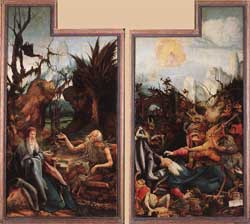
Ergotism, the disease caused by the toxic fungus that grows on grain crops, was a horrible way to die. The fungus most often grew on rye, a cereal grain that served as the common food of poor people in the Middle Ages. An early name for the disease was Holy Fire, after the tremendous burning sensations in the arms and legs as the toxins cut off circulation. When the fungus was baked into bread, it produced an LSD-like substance that caused victims to hallucinate. (One can only imagine the tormented visions they suffered.) An order of monks built hospitals that provided care for the victims of ergotism. The monks dedicated their works to St. Anthony, and eventually the disease was given the name St. Anthony's Fire.
The suffering of disease victims inspired artists of the times. For example, modern museum goers are fascinated by the paintings of Hieronymus Bosch (c. 1450–1516). Bosch filled his canvases with fanciful creatures, deformed monsters, and scary demons. Bosch lived near the end of the Middle Ages and was familiar with the folklore and superstitions of the times. He also would have known about diseases such as St. Anthony's Fire. He was a religious man, and many of his paintings portrayed religious themes. One of his most famous paintings, The Temptation for Saint Anthony, portrays the life of this celebrated saint. Yet this painting obviously does much more than tell a religious story. It shows a weird landscape populated by fanciful animals, odd objects, and strange people. It is a fascinating challenge to study this painting to try to understand its symbolism - is Bosch perhaps trying to portray his vision of hell?
Written and revised by
Gerald Hurowitz, M.D.
Our doctors write and review articles for accuracy and keep them up to date.
health.am provides general information, not medical advice. Always consult a qualified health professional about your own health.
Explore health topics
More in this topic
Weight & Nutrition → News
Use wipes in the kitchen to reduce risk of food poisoning by 99 percent Wiley
Consumers can reduce the risk of Campylobacter food poisoning by up to 99.2% by using disinfectant wipes in the kitchen after preparing poultry. This is according to research published today (Friday 01 May) in the…
2 May 2015
 News
Keeping food visible throughout the house is linked to obesity
Researchers have identified two seemingly unrelated but strong predictors of obesity: having low self-esteem related to one's weight and keeping food visibly available around the house, outside the kitchen. The Ohio…
29 April 2015
 News
Obese people may be more sensitive to food smells
Obese people are better at detecting the scent of chocolate and find it more pleasant than non-obese people, according to a small UK study. Recent research suggests that smell plays a large role in people's food intake,…
6 April 2015