Developing Food Safety Measures
Key points
- Over time, as the food supply was transferred more and more from local farm families into the hands of food producers and merchants, more opportunities for accidental or intentional contamination arose.
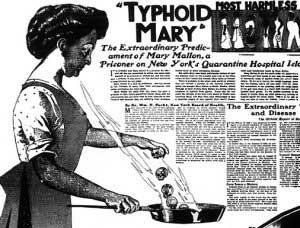
- When Irish immigrant Mary Mallon first encountered the public health system of New York City, she greeted a visiting health official with harsh words and a meat fork in her hand.
- Dairy cows that provided milk for the early residents of New York City were fed such a meager diet that their milk took on a bluish color, and it was delivered to local neighborhoods by the same trucks that carted away the cow manure.
- Advances in science during the 1800s and early 1900s awoke people to the fact that many of the illnesses from which they suffered could be traced to their food and drink.
Over time, as the food supply was transferred more and more from local farm families into the hands of food producers and merchants, more opportunities for accidental or intentional contamination arose. In nineteenth-century England, beer, wine, bread, and other foods were routinely adulterated with cheaper ingredients by their makers. Usually, the intent was merely to substitute a cheaper product so the merchant could make a bigger profit, but some of the substituted ingredients had unhealthy side effects.
Dairy cows that provided milk for the early residents of New York City were fed such a meager diet that their milk took on a bluish color, and it was delivered to local neighborhoods by the same trucks that carted away the cow manure. People began to give more thought to their food purchases and demanded action from public officials to assure the safety and purity of their food.
Advances in science during the 1800s and early 1900s awoke people to the fact that many of the illnesses from which they suffered could be traced to their food and drink. John Snow, a London physician, became suspicious when he noted that patients who were suffering from an 1854 cholera outbreak were concentrated in a single neighborhood. He drew up elaborate maps showing exactly where they lived and eventually traced the cause of the outbreak to water from a single contaminated well that supplied all of their houses. Snow's investigation is regarded as the beginning of epidemiology, the study of the factors that cause illnesses in populations. Years later, scientists working in the new field of microbiology identified the organism that caused cholera, along with causative agents for other waterborne and foodborne illnesses.
From 1902 to 1907, the attention of the American public was riveted on the eating habits of 12 young men who came to be known as the "Poison Squad." A popular song was even written about them and what they ate. These young men volunteered to eat their meals in the basement of the U.S. government's Bureau of Chemistry in Washington, D.C. Scientists observed the men for changes in their health and digestion after they dined on meals spiked with various food additives. The experiments were authorized by Congress and duly reported in newspapers and scientific publications of the day. While some might question the scientific value of these early experiments in food safety, there is no question about their impact on the American public. This period also saw the publication of e Jungle, Upton Sinclair's famous novel that exposed the horrible unsanitary conditions within the Chicago meatpacking industry.
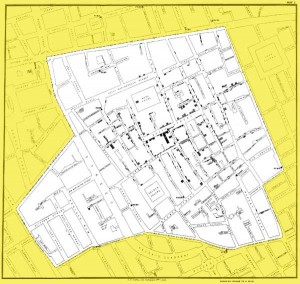
FIGURE 1.4 This map, made in 1854 by Dr. John Snow, highlights deaths from cholera (each one represented by a black dash) and nearby water pumps, which were suspected to be contaminated, in a London neighborhood.
Written and revised by
Gerald Hurowitz, M.D.
Our doctors write and review articles for accuracy and keep them up to date.
health.am provides general information, not medical advice. Always consult a qualified health professional about your own health.
Explore health topics
More in this topic
Weight & Nutrition → News
Food ads during children’s TV don’t meet proposed guidelines
On network and cable TV, during shows aimed at kids under age 12, the vast majority of commercials are for products with too much added sugar, saturated fat or sodium, according to a new study. Researchers compared the…
10 May 2015
 News
Use wipes in the kitchen to reduce risk of food poisoning by 99 percent Wiley
Consumers can reduce the risk of Campylobacter food poisoning by up to 99.2% by using disinfectant wipes in the kitchen after preparing poultry. This is according to research published today (Friday 01 May) in the…
2 May 2015
 News
Keeping food visible throughout the house is linked to obesity
Researchers have identified two seemingly unrelated but strong predictors of obesity: having low self-esteem related to one's weight and keeping food visibly available around the house, outside the kitchen. The Ohio…
29 April 2015