
Schizophrenia in African Americans
Key points
- Schizophrenia is considered the most severe psychiatric disorder.
- Nevertheless, recent clinical studies continue to report an overdiagnosis of schizophrenia in African Americans despite controls for a variety of settings.
- Clinical handbook of schizophrenia / edited by Kim T.
- Epidemiology African Americans have always been viewed as being overdiagnosed with schizophrenia.
Schizophrenia is considered the most severe psychiatric disorder. It has a poor prognosis, an unknown etiology, and an age of onset in the late teens and early 20s, when many individuals finish their education and begin their careers. Current treatments are mostly palliative, with uncertain recovery and rarely substantiated cures. Individuals and their families often face a lifetime of illness that is associated with individual and societal morbidity, shortened lifespan, and high suicide rates. Recent advances have led to improved diagnostic accuracy, a better understanding of genetic risks and psychosocial stressors, and improved treatment that has made recovery an attainable goal. This chapter indicates that race and ethnicity impact the diagnosis, course, and treatment of this illness through biopsychosocial factors that are only beginning to be appreciated. The focus is on African Americans, for whom there is a more extensive literature than for other ethnic minorities.
Epidemiology
African Americans have always been viewed as being overdiagnosed with schizophrenia.
Even recent clinical reports show that African Americans are at as much as a tenfold increased risk over other ethnic minorities despite improved diagnostic accuracy and widespread use of the DSM-III and DSM-IV. Lawson, Hepler, Holladay, and Cuffel (1994) reported that African Americans in both inpatient and outpatient settings were diagnosed with schizophrenia at higher percentage rates than African Americans in the overall population.
Rates of mood disorder for African Americans, and both schizophrenia and affective disorders for European Americans were the same as rates in the general population. Strakowski and colleagues (2003) reported higher rates of schizophrenia for African Americans in inpatient and outpatient settings. The higher rates were often associated with correspondingly lower rates of affective disorders.
The findings have generally been assumed to reflect affective disorders misdiagnosed as schizophrenia. These differences often disappeared with the use of structured interviews, which presumably minimize bias. Large-scale, door-to-door epidemiological surveys have tended to support this interpretation as well. The Epidemiologic Catchment Area study, which sampled five major cities and oversampled ethnic minorities, found no difference between African Americans and other ethnic groups when socioeconomic class was controlled. The National Cormobidity Survey and the more recent National Comorbidity Survey Replication found that African Americans were less likely to have nonaffective psychosis, which is primarily schizophrenia.
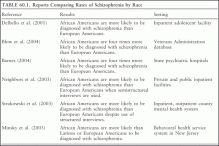
TABLE 60.1. Reports Comparing Rates of Schizophrenia by Race
Written and revised by
David Cohen, M.D.
Our doctors write and review articles for accuracy and keep them up to date.
health.am provides general information, not medical advice. Always consult a qualified health professional about your own health.
Explore health topics
More in this topic
Mental Health → News
Scientists reconcile three unrelated theories of schizophrenia
A new Duke University study in mice links three previous and, until now, apparently unrelated hypotheses about the causes of schizophrenia, a debilitating mental disorder appearing in late adolescence that affects how…
5 May 2015
 News
TSRI scientists find molecular trigger of schizophrenia-like behaviors and brain changes
Scientists at The Scripps Research Institute (TSRI) have identified a molecule in the brain that triggers schizophrenia-like behaviors, brain changes and global gene expression in an animal model. The research gives…
9 April 2015
 News
Brain networks differ among those with severe schizophrenia, CAMH study shows
People with a severe form of schizophrenia have major differences in their brain networks compared to others with schizophrenia, bipolar disorder and healthy individuals, a new study from the Centre for Addiction and…






