
Pharmacotherapy - Schizophrenia in African Americans
Key points
- Although psychosocial support is important in managing schizophrenia, pharmacotherapy remains essential for maintenance and recovery.
- Moreover, some of the newer antipsychotic agents are not predominately metabolized through the CYP450 2D6 system and are instead metabolized through CYP450 1A2, with CYP450 2D6 as a minor pathway.
- Clinical handbook of schizophrenia / edited by Kim T.
- Also note that some of the typical agents and high doses may have been a consequence of the use of depot medication, for which only one atypical agent is now available, and no atypical form was available at the time of many of the studies.
Although psychosocial support is important in managing schizophrenia, pharmacotherapy remains essential for maintenance and recovery. Unfortunately, the treatment of ethnic minorities is often inappropriate. African Americans often receive excessive doses of medication, whereas Hispanics and Asians receive lower medication doses, when treated by ethnic providers. Moreover African Americans are more likely to receive first-generation rather than second-generation or atypical medications, higher doses of medication, and more depot medication. Table 60.2 summarizes findings about the medicating of African Americans. Please note that some of the studies involved Medicaid or Veterans Administration hospital patients, and income presumably should not have affected the difference.
Also note that some of the typical agents and high doses may have been a consequence of the use of depot medication, for which only one atypical agent is now available, and no atypical form was available at the time of many of the studies. Yet when the use of depot medication was controlled, the high dosing of typical medication persisted.
The biological evidence, if anything, supports lower dosing for ethnic minorities.
Ethnic differences have been found in the way many psychotropic agents are metabolized through the cytochrome P450 family of liver isoenzymes. The CYP450 2D6 isoenzyme in particular shows ethnic variation. Relative to the majority of European Americans, Asians, Hispanics, and African Americans show reduced activity in this enzyme, whereas many Ethiopians show increased activity. Reduced activity means that a drug is metabolized more slowly, therefore having higher plasma levels. Individuals with CYP450 2D6 alleles associated with reduced or no activity who are given standard medication doses are more likely to have extrapyramidal side effects on antipsychotics and to discontinue treatment, whereas those with increased activity may not show any response at all. Thus, there is no biological reason for the excessive dosing of African Americans.
Pharmacological studies provide some support for prescribing atypical antipsychotics to African Amerians. Second-generation, or atypical antipsychotics, are less likely to cause extrapyramidal side effects and are believed to cause less tardive dyskinesia.
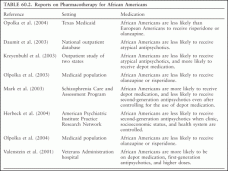
TABLE 60.2. Reports on Pharmacotherapy for African Americans
Moreover, some of the newer antipsychotic agents are not predominately metabolized through the CYP450 2D6 system and are instead metabolized through CYP450 1A2, with CYP450 2D6 as a minor pathway. Asians and Hispanics are more likely than European Americans to experience movement disorder side effects, such as acute dystonic reactions, when given typical or first-generation antipsychotics. African Americans are twice as likely as European Americans to develop tardive dyskinesia on typical antipsychotics. African Americans are also more likely than European Americans to experience acute extrapyramidal symptoms with typical antipsychotics, but these differences disappear with atypical agents.
Written and revised by
Gerald Hurowitz, M.D.
Our doctors write and review articles for accuracy and keep them up to date.
health.am provides general information, not medical advice. Always consult a qualified health professional about your own health.
Explore health topics
More in this topic
Mental Health → News
Scientists reconcile three unrelated theories of schizophrenia
A new Duke University study in mice links three previous and, until now, apparently unrelated hypotheses about the causes of schizophrenia, a debilitating mental disorder appearing in late adolescence that affects how…
5 May 2015
 News
TSRI scientists find molecular trigger of schizophrenia-like behaviors and brain changes
Scientists at The Scripps Research Institute (TSRI) have identified a molecule in the brain that triggers schizophrenia-like behaviors, brain changes and global gene expression in an animal model. The research gives…
9 April 2015
 News
Brain networks differ among those with severe schizophrenia, CAMH study shows
People with a severe form of schizophrenia have major differences in their brain networks compared to others with schizophrenia, bipolar disorder and healthy individuals, a new study from the Centre for Addiction and…






