Schizophrenia Differential Diagnosis
Key points
- Psychotic symptoms in children and adolescents are diagnostically non-specific, occurring in a wide range of functional psychiatric, neurodevelopmental and organic brain disorders.
- The diagnostic status of this group remains to be resolved.
- Psychotic symptoms can occur in temporal and frontal lobe partial seizures.
- Rare neurodegenerative disorders occurring in late childhood and adolescence can mimic schizophrenia.
Psychotic symptoms in children and adolescents are diagnostically non-specific, occurring in a wide range of functional psychiatric, neurodevelopmental and organic brain disorders.
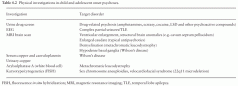
The differential diagnosis of schizophrenia in childhood and adolescence is summarized in Table 4.1. A summary of physical investigations in children and adolescents with suspected schizophrenia is listed in Table 4.2.
Affective, schizoaffective and 'atypical' psychoses
The high rate of positive psychotic symptoms found in adolescent onset major depression and mania can lead to diagnostic confusion (Joyce 1984). Affective psychoses are most likely to be misdiagnosed as schizophrenia if a rigid Schneiderian concept of schizophrenia is applied with its emphasis on first-rank symptoms.
Because significant affective symptoms also occur in about one-third of first-episode patients with schizophrenia, it may be impossible to make a definitive diagnosis on the basis of a single cross-sectional assessment. In DSM-IV the distinction between schizophrenia, schizoaffective disorder and affective psychoses is determined by the relative predominance and temporal overlap of psychotic symptoms (hallucinations and delusions) and affective symptoms (elevated or depressed mood). Given the difficulty in applying these rules with any precision, there is a need to identify other features to distinguish between schizophrenia and affective psychoses. Irrespective of the presence of affective symptoms, the most discriminating symptoms of schizophrenia are an insidious onset and the presence of negative symptoms (Hollis 1999). Similarly, complete remission from a first psychotic episode within 6 months of onset is the best predictor of a diagnosis of affective psychosis (Hollis 1999). Schizoaffective and atypical psychoses are unsatisfactory diagnostic categories with low predictive validity and little longitudinal stability (Hollis 2000).
Autistic spectrum and developmental language disorders
Kolvin (1971), in a landmark study, clearly distinguished the symptoms and correlates of core autism with onset before age 3 from adult-type schizophrenia beginning in late childhood and early adolescence. However, some children on the autistic spectrum (usually with atypical autism or Asperger syndrome) have social and cognitive impairments that overlap closely with the premorbid phenotype described in schizophrenia. Furthermore, children on the autistic spectrum may also develop psychotic symptoms in adolescence (Volkmar & Cohen 1991).
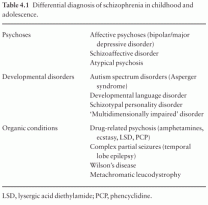
Towbin et al. (1993) have labelled another group of children who seem to belong within the autistic spectrum as having 'multiplex developmental disorder'. An increased risk for psychosis has also been noted in developmental language disorders (Rutter & Mawhood 1991). While some children on the autistic spectrum can show a clear progression into classic schizophrenia, others show a more episodic pattern of psychotic symptoms without the progressive decline in social functioning and negative symptoms characteristic of child and adolescent onset schizophrenia.
Written and revised by
Andrey Nailor, M.D.
Our doctors write and review articles for accuracy and keep them up to date.
health.am provides general information, not medical advice. Always consult a qualified health professional about your own health.
Explore health topics
More in this topic
Mental Health → News
Diagnosis of psychiatric disorders not as important as outcomes
Nailing the diagnosis of a psychiatric disorder may not be important in prescribing effective treatment, according to Mark Zimmerman, M.D., a clinical researcher at Rhode Island Hospital. His opinion editorial was…
26 July 2015
 News
New Clues to Schizophrenia Pathogenesis
The composition of the oropharyngeal virome in patients with schizophrenia differs from that of healthy persons, and understanding the pathologic consequences of these differences may open up new avenues for therapeutic…
13 July 2015
NewsStudy identifies brain abnormalities in people with schizophrenia
Structural brain abnormalities in patients with schizophrenia, providing insight into how the condition may develop and respond to treatment, have been identified in an internationally collaborative study led by a…