Schizophrenia Diagnosis and differential diagnosis
Key points
- However, simply finding that some children fulfil adult diagnostic criteria for schizophrenia tells us nothing about whether the diagnosis is valid for this age group.
- The cognitive level of the child influences their ability to understand and express complex psychotic symptoms such as passivity phenomena, thought alienation and hallucinations.
- Developmental maturation can also affect the localization of hallucinations in space.
- In the absence of a biological diagnostic test, demonstrating diagnostic validity requires evidence that these early onset cases more closely resemble adult onset schizophrenia than other disorders in terms of clinical course, treatment response, family history and neurobiological correlates.
Diagnostic validity
There is now compelling evidence that schizophrenia can be identified using unmodified adult criteria in children as young as 7 years of age (Green et al. 1984; Russell et al. 1989; Werry 1992). However, simply finding that some children fulfil adult diagnostic criteria for schizophrenia tells us nothing about whether the diagnosis is valid for this age group. In the absence of a biological diagnostic test, demonstrating diagnostic validity requires evidence that these early onset cases more closely resemble adult onset schizophrenia than other disorders in terms of clinical course, treatment response, family history and neurobiological correlates.
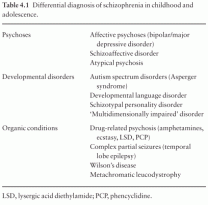
There are dangers of slavishly applying unmodified adult diagnostic criteria to children and adolescents. First, if a degree of age-dependent symptom variation exists in schizophrenia then applying unmodified adult criteria may result in some 'true' cases being missed (false-negative diagnoses). Secondly, some presentations of schizophrenia in early life could simply be phenocopies of adult schizophrenia (false-positive diagnoses) with a separate aetiology and clinical course. Hence, two issues need to be addressed. First, what is the validity of adult diagnostic criteria for schizophrenia when applied in childhood and adolescence? Secondly, are there partial syndromes or developmental variants of schizophrenia in childhood and adolescence that should be included as part of a broader schizophrenic spectrum?
Good evidence for the validity of the diagnosis of schizophrenia in childhood and adolescence comes from the recent Maudsley Child and Adolescent Psychosis Follow-up Study (Hollis 2000).
The study was based on 110 cases of child and adolescent onset psychoses (mean age of onset 14.2 years, range 10 - 17 years) presenting as a consecutive series to the Maudsley Hospital from 1973 to 1991 (we refer to this subsequently as 'the Maudsley study'). The study used a 'catch-up' longitudinal design in which DSM-IIIR diagnoses were retrospectively applied to adolescent first-episode case notes and 85% (93/110) of the original cohort were then reassessed on average 11 years after their first admission. Of the 93 cases followed up, 51 had a baseline diagnosis of schizophrenia while 42 had a non-schizophrenic psychosis (bipolar, schizoaffective or atypical psychosis). The key findings with respect to diagnostic validity were as follows:
1 A DSM-IIIR diagnosis of schizophrenia in childhood and adolescence predicted a significantly poorer adult outcome compared with other non-schizophrenic psychosis.
2 The diagnosis of schizophrenia showed a high level of stability, with 80% having the same diagnosis recorded at adult follow-up.
These findings support the predictive validity of the DSM-IIIR diagnosis of schizophrenia in childhood and adolescence, and are likely to be equally applicable to DSM-IV criteria. The level of diagnostic stability for child and adolescent onset schizophrenia (using DSM-IIIR criteria) was very similar to that described in follow-up studies of adult first-episode schizophrenia.
Written and revised by
Gerald Hurowitz, M.D.
Our doctors write and review articles for accuracy and keep them up to date.
health.am provides general information, not medical advice. Always consult a qualified health professional about your own health.
Explore health topics
More in this topic
Mental Health → News
Diagnosis of psychiatric disorders not as important as outcomes
Nailing the diagnosis of a psychiatric disorder may not be important in prescribing effective treatment, according to Mark Zimmerman, M.D., a clinical researcher at Rhode Island Hospital. His opinion editorial was…
26 July 2015
 News
New Clues to Schizophrenia Pathogenesis
The composition of the oropharyngeal virome in patients with schizophrenia differs from that of healthy persons, and understanding the pathologic consequences of these differences may open up new avenues for therapeutic…
13 July 2015
NewsStudy identifies brain abnormalities in people with schizophrenia
Structural brain abnormalities in patients with schizophrenia, providing insight into how the condition may develop and respond to treatment, have been identified in an internationally collaborative study led by a…