David Cohen, M.D.·Published 22 August 2011·11 min read
Key points
Cognitive abilities include perception, memory, judgment, perceptual speed, spatial manipulation and reasoning.
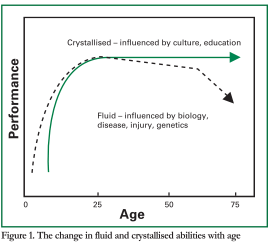
As shown in Figure 1, the developmental trajectory of fluid abilities is thought to follow neurological maturation, peaking in the mid 20s and thereafter declining gradually until the 60s when a more rapid decline takes place.
There are large individual differences in the amount of decline experienced by individuals and in the patterns of decline across different abilities within an individual.
The significance of decline in cognitive abilities is partially determined by the individual's previous level of cognitive function.
Cognitive abilities include perception, memory, judgment, perceptual speed, spatial manipulation and reasoning. Both cross sectional and longitudinal studies have shown that different cognitive abilities have different developmental trajectories across the lifespan, and may be grouped into two broad types.
The first type is described as 'crystallised' and involves accumulated knowledge and expertise and relies on long term memory. Crystallised abilities are assessed with tests of vocabulary, word knowledge, general knowledge, understanding proverbs, and measures of occupational expertise.
The second type are known as 'fluid' and involve novel problem solving, spatial manipulation, mental speed, and identifying complex relations among stimulus patterns.
These are usually measured with tests that involve identifying the next in a series of abstract patterns, matrices or a series of numbers. Fluid abilities rely on short term memory storage while processing information.
Normal cognitive aging
As shown in Figure 1, the developmental trajectory of fluid abilities is thought to follow neurological maturation, peaking in the mid 20s and thereafter declining gradually until the 60s when a more rapid decline takes place. Fluid abilities are affected by neurological insult, genetics and biological aging processes. In contrast, crystallised abilities increase during the lifespan through education, occupational and cultural experience and exposure to culture and intellectual pursuits. They are less affected by aging and disease and often remain intact in the early stages of dementia or after brain injury. The rate of increase in crystallised abilities is thought to slow in late adulthood, and there is some evidence they may decrease slowly from the ninth decade onward. The observation that older adults often have intact long term memory but poor short term memory, reflects the different effects of age on these abilities.
Behavioural changes also accompany normal cognitive aging. Older adults are more variable in their responses on cognitive tests than younger adults. For example, on a test of reaction time, older adults may have a higher mean performance indicating that overall they are slower than younger adults, but they will also have more very long trials and very short trials indicating greater variability about the mean. Compared with younger adults, older adults are more likely to fluctuate in their performance from day-to-day, and week-to-week, and those with neurological conditions fluctuate more than healthy older adults. Cognitive aging is also characterised by generalised behavioural slowing, both in laboratory tasks and everyday situations. Older adults also have more difficulty selectively attending to information and inhibiting irrelevant information or stimuli. This has been linked with frontal lobe atrophy in aging.
How much cognitive decline is normal?
Written and revised by
David Cohen, M.D.
Our doctors write and review articles for accuracy and keep them up to date.
health.am provides general information, not medical advice. Always consult a qualified health professional about your own health.
There are large individual differences in the amount of decline experienced by individuals and in the patterns of decline across different abilities within an individual. At a group level, there is a decline of between one and two standard deviations (15-30 IQ points) in fluid type abilities between the ages of 20-70. After then, the average decline in fluid abilities accelerates to about 0.5 of a standard deviation per decade.
A practical indication of the amount of decline in normal aging can be gained from the norms for commonly used cognitive tests. On a 33 item vocabulary test, there will be no difference in the average score for a 25 year old and a 70 year old. However, on test of recall of digits in the order in which they are presented, the average 25 year old will recall about seven, whereas the average 65 year old will recall about 5. On a test of coding speed conducted within a time limit of 90 seconds, the average 25 year old will code about 78 items correctly, whereas the average 70 year old will code about 51 items correctly.
Clinical evaluation of premorbid cognitive function
The significance of decline in cognitive abilities is partially determined by the individual's previous level of cognitive function. This is called their 'premorbid' intelligence, and is assessed by measures of verbal reasoning and word knowledge (crystallised abilities). Those who start at a low level may reach the threshold for a cognitive disorder after a small amount of decline, whereas those who start at a higher level will need to decline more before they are diagnosed as clinically impaired. Any assessment of cognitive impairment by a neuropsychologist would involve assessing premorbid cognitive function through psychometric testing and interview. Information about previous occupational level, interests, educational level from the individual, and an informant, additionally contribute to a clinical estimate of premorbid ability.
Memory complaints in normal aging
Memory complaints are common among older adults and are more prevalent among the very old, women, and those with low levels of education. A number of studies have been conducted to determine whether individuals who complain of memory difficulties have memory disorders or are at greater risk of developing memory disorders or dementia.
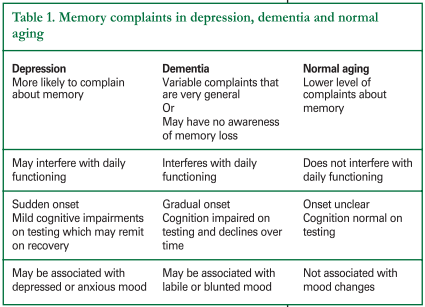
Results of individual studies have been inconsistent and a recent review reported that self referrals for memory complaints are not a good indicator of cognitive impairment and are more likely to be associated with depression in older adults. On the other hand, memory complaints are a diagnostic criteria for mild cognitive impairment (MCI) and in patients with cognitive impairment, memory complaints are predictive of cognitive decline. Table 1 outlines the different patterns accompanying memory complaints in normal aging, depression and dementia.
Mild cognitive impairment
While moderate to severe cognitive deficits impair the individual's capacity to conduct activities of daily living, the cognitive changes in the preclinical stages of dementia do not. Over the past 15 years, a large amount of research has been directed toward developing screening tests and criteria to identify individuals in the preclinical phase of dementia. The diagnosis of MCI has been developed for research studies, particularly drug trials that focus on the detection and early intervention of dementia. The criteria for MCI include:
subjective memory complaint
preserved general intellectual function demonstrated on performance of a test of general cognitive abilities such as the mini-mental state examination (MMSE)
impaired memory relative to age and education
no impairment in performance of activities of daily living, and
the absence of dementia.
{pagebreak}
There are limitations with this classification. Only 10-15% of patients diagnosed with MCI convert to dementia per year in clinical populations and 5-10% in the community.
A substantial proportion are diagnosed as normal at follow up. The criteria are circular to some extent (ie. the absence of dementia) and there has been criticism of the focus on memory impairment as the exclusive cognitive deficit because some dementias begin with other cognitive deficits or personality change. For example, fronto-temporal dementia begins with changes in behaviour (eg. disinhibition, apathy, obsessive compulsive behaviour) and semantic dementia begins with language problems. Nevertheless, the MCI diagnosis fills a gap that is important both clinically and for researchers, and until an objective test of preclinical dementia is developed, it remains a necessary classification.
Differentiating normal changes from dementia
Unfortunately, there are no hard and fast rules to easily distinguish between normal aging and dementia.
Differentiating normal cognitive aging from MCI and early stage dementia requires formal assessment by a neurologist, geriatrician or psychogeriatrician, and ideally, a neuropsychologist. Screening instruments are available for use in general practice, but these only yield a cut-off score that is associated with an established risk in population based studies. The MMSE is a widely used instrument in which scores under 24 are generally taken to indicate cognitive impairment.
However, the scale is inaccurate, with highly educated patients less likely to be diagnosed and patients from non-English speaking backgrounds more likely to be diagnosed. This is because parts of the test are based on English literacy and numeracy skills. Another instrument available in Australia is the GPCOG, which has been developed for use by GPs. This combines cognitive testing with informant interview and takes 4-6 minutes to administer. When validated in an Australian primary care population, the GPCOG performed with a sensitivity of 0.85, specificity of 0.86, misclassification rate of 14%, and positive predictive value of 71.4%. It appears to be free of an education bias, but has not been tested for language and culture biases.
Key considerations for diagnosis of a cognitive disorder include:
a history of decline in cognitive abilities
evidence that this decline interferes with everyday activities, and
impairment in more than one cognitive domain.
Interviewing an informant is the best way of obtaining an accurate history. Patients who present a diagnostic challenge include those with low education, premorbid intellectual disability, those currently suffering another mental health condition such as depression or psychosis, and those from a non-English speaking background.
{pagebreak}
Risk factors
Risk factors for cognitive decline and dementia are similar, with the strongest risk factor being age. Other factors consistently associated with both cognitive decline and dementia include:
the APOE e4 allele
head injury with loss of consciousness
risk factors for cardiovascular disease (diabetes, stroke, smoking, physical inactivity, high LDL cholesterol, obesity), and
low level of education.
Factors moderated by lifestyle may have an impact from midlife, and possibly earlier. The association between blood pressure and cognitive decline is complicated. High blood pressure in midlife appears to increase the risk of cognitive decline and in general hypertension is associated with an increased risk of vascular dementia and Alzheimer disease; however, in adults over 75 years of age, low diastolic blood pressure may increase the risk of dementia.
Protective factors
Factors that have been shown to have a protective effect against cognitive decline and dementia include:
vitamin E
foods high in antioxidants and omega-3 fatty acids
mental and physical activity
social engagement, and
statins.
There is mixed support for the effect of oestrogen on cognitive decline.
Public health implications and directions for primary care
Latest research shows that lifestyle factors known to affect the risk of heart disease also affect the risk of developing 'normal' cognitive decline and dementia. Having a healthy heart in later life may also lead to a healthier brain due to reduction in the build up of cholesterol, increased perfusion, reduction in stroke and TIAs. However, the impact of these factors is very slow, so prevention strategies need to be implemented in early and mid adulthood.
Encouraging patients to adopt a healthier and more active lifestyle will reduce what is presently viewed as normal cognitive decline in the population.
{pagebreak}
Conclusion
Cognitive abilities, particularly those involving speed and problem solving, decline as part of normal aging, although many older adults retain high levels of cognitive function. These changes do not inevitably lead to dementia.
Assessment of premorbid ability is important in determining whether there has been abnormal cognitive decline and cognitive screening may also be helpful. Patients should be encouraged to have an active lifestyle and reduce cardiovascular risk factors in order to reduce the risk of cognitive decline.
Summary of important points
• In normal aging there is nonpathological cognitive decline. • Memory complaints are common in later life. Depending on presentation they may indicate normal aging, depression or impending cognitive decline. • Risk factors for cognitive aging include age, low education, the APOE genotype and risk factors for cardiovascular disease.
Conflict of interest: None.
###
References
1. Horn JL. A context for understanding information processing studies of human abilities. In: Vernon PA, ed. Speed of information processing and intelligence. Norwood, NJ: Ablex, 1987;201-238. 2. Christensen H. What cognitive changes can be expected with normal aging? Aust N Z J Psychiatry 2001;35:768-775. 3. Hultsch DF, MacDonald SW, Dixon RA. Variability in reaction time performance of younger and older adults. J Gerontol B Psychol Sci Soc Sci 2002;57:P101-P115. 4. Hultsch DF, MacDonald SW, Hunter MA, Levy-Bencheton J, Strauss E. Intraindividual variability in cognitive performance in older adults: comparison of adults with mild dementia, adults with arthritis, and healthy adults. Neuropsychology 2000;14:588-598. 5. Salthouse TA. Interrelations of aging, knowledge, and cognitive performance. In: Staudinger UM, Lindenberger U, eds. Understanding human development: dialogues with lifespan psychology. Dordrecht: Kluwer Academic Publishers, 2003. 6. Greenwood PM. The frontal aging hypothesis evaluated. J Int Neuropsychol Soc 2000;6:705-726. 7. Meguro K, Shimada M, Yamaguchi S, et al. Cognitive function and frontal lobe atrophy in normal elderly adults: implications for dementia not as aging related disorders and the reserve hypothesis. Psychiatry Clin Neurosci 2001;55:565-573. 8. Wechsler D. Wechsler Adult Intelligence Scale. 3rd edn. San Antonio, TX: The Psychological Corporation, 1997. 9. Mitrushina MN, Boone KB, D'Elia LF. Handbook of normative data for neuropsychological assessment. New York: Oxford University Press, 1999. 10. Jonker C, Geerlings MI, Schmand B. Are memory complaints predictive for dementia? A review of clinical and population based studies. Int J Geriatr Psychiatry 2000;15:983-991. 11. Petersen RC, Stevens JC, Ganguli M, Tangalos EG, Cummings JL, DeKosky ST. Practice parameter: early detection of dementia: mild cognitive impairment (an evidence based review). Report of the Quality Standards Subcommittee of the American Academy of Neurology. Neurology 2001;56:1133-1142. 12. DeCarli C. Mild cognitive impairment: prevalence, prognosis, aetiology, and treatment. Lancet Neurology 2003;2:15-21. 13. Lorentz WJ, Scanlan JM, Borson S. Brief screening tests for dementia. Can J Psychiatry 2002;47:723-733. 14. Brodaty H, Pond D, Kemp NM, et al. The GPCOG: a new screening test for dementia designed for general practice. J Am Geriatr Soc 2002;50:530-534. 15. Brodaty H, Kemp NM, Low LF. Characteristics of the GPCOG, a screening tool for cognitive impairment. Int J Geriatr Psychiatry 2004;19:1-5. 16. Kemp NM, Brodaty H, Pond D, Luscombe G. Diagnosing dementia in primary care: the accuracy of informant reports. Alzheimer Dis Assoc Disord 2002;16:171-176. 17. Gustafson D, Rothenberg E, Blennow K, Steen B, Skoog I. An 18 year follow up of overweight and risk of Alzheimer disease. Arch Intern Med 2003;163:1524-1528. 18. Haan MN, Wallace R. Can dementia be prevented? Brain aging in a population based context. Annu Rev Public Health 2004;25:1-24.
###
Kaarin J Anstey, BA (Hons), PhD, is NHMRC Career Development Fellow in Population Health, Director, Ageing Research Unit, Centre for Mental Health Research, Australian National University, and a psychologist, Canberra, Australian Capital Territory.
Lee-Fay Low,
BSc (Hons), is a PhD candidate, Centre for Mental Health Research, Australian National University, and a psychologist, Canberra, Australian Capital Territory. Reprinted from Australian Family Physician Vol. 33, No. 10, October 2004

 News
 News
 News