
Normal Aging and Dementia
Key points
- Memory Loss: Forgetting recently learned information is one of the most common early warning signs of Alzheimer's disease.
- Poor or Decreased Judgment: Has anyone told you lately that you dress inappropriately, wearing several layers on a warm day or little clothing in the cold?
- When assessing older patients, it is important to keep in mind the differences between normal and pathological changes that occur with aging.
- Difficulty Performing Familiar Tasks: Do you have difficulty planning or completing everyday tasks?
1. Memory Loss: Forgetting recently learned information is one of the most common early warning signs of Alzheimer's disease. Do you forget things more often or find yourself unable to recall information later? Do your friends or family tell you that you keep repeating the same question over and over again?
2. Difficulty Performing Familiar Tasks: Do you have difficulty planning or completing everyday tasks? Do you lose track of the steps involved in preparing a meal, placing a telephone call, or playing a game?
3. Problems with Language: Do you often forget simple familiar words or substitute unusual words? Do you mimic actions when you can't remember the words to describe them? People with dementia may be unable to think of the word "toothbrush" for instance and instead ask for "that thing in my mouth" or mimic the action of brushing their teeth.
4. Disorientation to Time and Place: Do you ever get lost in your own neighborhood, forgetting where you are or how you got there? Have you ever been unable to find your way home?
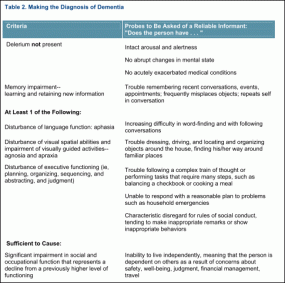
Making the Diagnosis of Dementia
5. Poor or Decreased Judgment: Has anyone told you lately that you dress inappropriately, wearing several layers on a warm day or little clothing in the cold? Do you ever show poor judgment, like giving away large sums of money or engaging with telemarketers who tell you you've won a sweepstakes?
6. Problems with Abstract Thinking: Do you ever have unusual difficulty performing complex mental tasks, like forgetting what numbers are for and how they should be used?
7. Misplacing Things: Do you ever put things in unusual place, such as your watch in the sugar bowl or your keys in the freezer?
8. Changes in Mood or Behavior: Do you experience rapid mood swings, from calm to anger or tears, for no reason?
9. Changes in Personality: The personalities of people with dementia can change dramatically. Have you become extremely confused, suspicious, fearful or dependent on family members?
10. Loss of Initiative: Have you become very passive, sitting in front of the TV for hours, sleeping more than usual? Have you lost interest in your usual activities?
###
Differentiating Normal Aging and Dementia
When assessing older patients, it is important to keep in mind the differences between normal and pathological changes that occur with aging.
Written and revised by
Gerald Hurowitz, M.D.
Our doctors write and review articles for accuracy and keep them up to date.
health.am provides general information, not medical advice. Always consult a qualified health professional about your own health.
Explore health topics
More in this topic
Mental Health → News
Alzheimer’s progression tracked prior to dementia
For years, scientists have attempted to understand how Alzheimer’s disease harms the brain before memory loss and dementia are clinically detectable. Most researchers think this preclinical stage, which can last a…
24 September 2013
 News
Hospital study finds connection between dementia, delirium and declining health
More than half of all patients with pre-existing dementia will experience delirium while hospitalized. Failing to detect and treat their delirium early leads to a faster decline of both their physical and mental health,…
17 September 2013
 News
High dose statins prevent dementia
Dr Lin said: "Statins are widely used in the older population to reduce the risk of cardiovascular disease. But recent reports of statin-associated cognitive impairment have led the US Food and Drug Administration (FDA)…






